


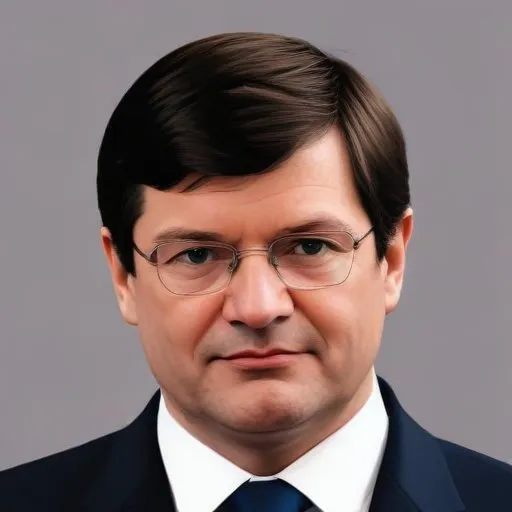
A Dutch jurist and politician who served as Prime Minister of the Netherlands from 2002 to 2010, known for his Christian democratic views and leadership during a period of significant social and economic change.
Jan Peter Balkenende, a Dutch politician and jurist, is renowned for serving as the Prime Minister of the Netherlands from 2002 to 2010, leading three consecutive cabinets and leaving an indelible mark on the country's politics and economy. As the leader of the Christian Democratic Appeal (CDA) party, Balkenende navigated the complexities of Dutch politics, fostering a reputation for stability, prudence, and vision.
Born on May 7, 1956, in Biezelinge, Netherlands, Balkenende studied History and Law at the Free University Amsterdam, earning Master of Arts and law degrees. He later obtained a PhD in governmental studies and worked as a professor of Christian theology at his alma mater from 1993 to 2002.
Following the 1998 election, Balkenende was elected as a Member of the House of Representatives, serving as a frontbencher and spokesperson for Finances. After Party Leader Jaap de Hoop Scheffer stepped down, Balkenende announced his candidacy and was selected as his successor on October 1, 2001. His leadership skills and vision propelled him to the forefront of Dutch politics.
As the Lijsttrekker (top candidate) for the 2002 election, Balkenende formed the Cabinet Balkenende I, becoming Prime Minister of the Netherlands on July 22, 2002. Despite the cabinet's fall just 87 days later, Balkenende persevered, serving as Prime Minister for three consecutive cabinets (Balkenende II, III, and IV) until October 14, 2010.
Balkenende's tenure was marked by significant economic and social reforms, including the introduction of a new healthcare system, pension reform, and measures to combat climate change. His commitment to European integration and his role in shaping the EU's Lisbon Treaty solidified the Netherlands' position within the European Union.
Balkenende's philosophical outlook is rooted in Christian democracy, emphasizing the importance of social cohesion, solidarity, and individual freedom. He has been vocal about the need for a more nuanced approach to European integration, balancing national sovereignty with supranational cooperation.
Balkenende's leadership has had a lasting impact on Dutch society, inspiring a new generation of politicians and shaping the country's approach to governance, economy, and international relations. His commitment to European integration and his role in shaping the EU's Lisbon Treaty have contributed to a more unified and prosperous Europe.
Balkenende's leadership style has been likened to that of German Chancellor Angela Merkel, with both leaders sharing a commitment to European integration and fiscal prudence. His pragmatic approach to politics has drawn comparisons to British Prime Minister Tony Blair, who also championed a third way approach to governance.
Balkenende's tenure as Prime Minister has inspired numerous satirical depictions in Dutch media, with his image often being caricatured in cartoons and comedy sketches.
87 Years Old
Led the Netherlands as Prime Minister from 1994 to 2002, implementing significant economic reforms and guiding the country's integration into the European Union. He's also known for his role in shaping the country's social and economic policies.
87 Years Old
The Prime Minister of the Netherlands from 1982 to 1994, known for leading the country through a period of economic growth and implementing significant welfare state reforms. He also served as the United Nations High Commissioner for Refugees from 2001 to 2005.
59 Years Old
The Prime Minister of the Netherlands, leading the country since 2010, known for his economic policies and handling of the European migrant crisis.
78 Years Old
The 11th Secretary General of NATO, a Dutch diplomat and politician, is known for leading the alliance during a critical period of global security challenges, including the War in Afghanistan. He played a key role in shaping NATO's response to emerging threats.
