


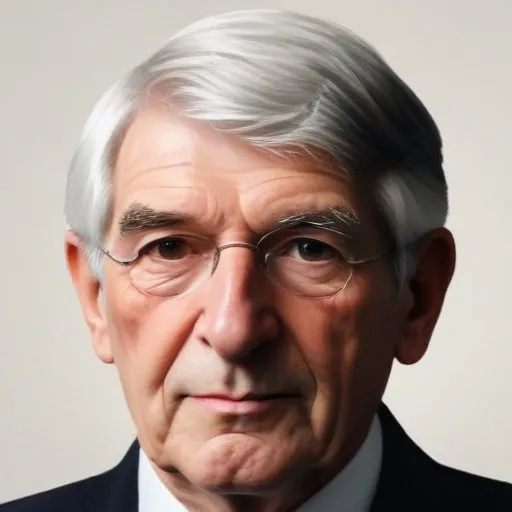
The Prime Minister of the Netherlands from 1982 to 1994, known for leading the country through a period of economic growth and implementing significant welfare state reforms. He also served as the United Nations High Commissioner for Refugees from 2001 to 2005.
Ruud Lubbers, the former Prime Minister of the Netherlands, is renowned for his remarkable tenure from 1982 to 1994 and his subsequent role as the United Nations High Commissioner for Refugees from 2001 to 2005. During his illustrious career, he left an indelible mark on the nation's politics, economy, and social landscape.
Ruud Lubbers was born on May 7, 1939, in Rotterdam, Netherlands. He pursued his academic interests at the Erasmus School of Economics, earning a Master of Science degree in Economics. This solid foundation in economics would later prove instrumental in shaping his political and business career.
Lubbers' early professional life was marked by his work as a corporate director for Hollandia, a manufacturing company in Rotterdam, and as a trade association executive for the Christian Employers Association. His leadership skills and economic expertise soon caught the attention of the political establishment. In 1973, he was appointed Minister of Economic Affairs in the Cabinet Den Uyl, marking the beginning of his remarkable political journey.
During his tenure as Prime Minister, Lubbers implemented a series of reforms that transformed the Dutch economy. He successfully reduced the national debt, lower taxes, and stimulated economic growth. His leadership also played a crucial role in shaping the European Union, as he was a strong advocate for European integration.
In his subsequent role as the United Nations High Commissioner for Refugees, Lubbers worked tirelessly to provide humanitarian aid and protection to millions of refugees worldwide. His dedication to this cause earned him international recognition and admiration.
Ruud Lubbers received numerous awards and honors for his outstanding contributions to politics, economics, and humanitarian causes. Some of his notable awards include the title of Minister of State, the Grand Cross of the Order of Orange-Nassau, and the Honorary Doctorate from the University of Maastricht.
Aside from his illustrious career, Lubbers was known for his strong family values and commitment to his Catholic faith. He was married to Ria Hoogeweegen, and they had three children together. Throughout his life, he remained deeply committed to social causes, and his philanthropic efforts continued to inspire generations.
Despite his numerous achievements, Lubbers was not immune to controversy. He faced criticism for his handling of asylum seekers and his stance on environmental issues. However, his commitment to public service and his unwavering dedication to his principles ultimately earned him a place in the annals of Dutch history.
Ruud Lubbers' legacy extends far beyond his political tenure. He played a pivotal role in shaping the Netherlands' economic and social landscape, and his humanitarian work continues to inspire future generations. His commitment to European integration and his dedication to protecting refugees have left an indelible mark on modern society.
Ruud Lubbers' remarkable life and career serve as a testament to the power of visionary leadership, dedication, and compassion. As we reflect on his life's work, we are reminded of the importance of public service, humanitarianism, and the pursuit of a better world for all.
59 Years Old
The Prime Minister of the Netherlands, leading the country since 2010, known for his economic policies and handling of the European migrant crisis.
70 Years Old
A Dutch jurist and politician who served as Prime Minister of the Netherlands from 2002 to 2010, known for his Christian democratic views and leadership during a period of significant social and economic change.
87 Years Old
Led the Netherlands as Prime Minister from 1994 to 2002, implementing significant economic reforms and guiding the country's integration into the European Union. He's also known for his role in shaping the country's social and economic policies.
Born in 1919
A Dutch journalist, economist, and politician who served as Deputy Prime Minister of the Netherlands, known for his progressive policies and efforts to reduce economic inequality. He played a key role in shaping the country's social and economic landscape.
95 Years Old
A Dutch statesman who served as Prime Minister of the Netherlands from 1977 to 1982, known for his progressive policies and European integration efforts.
Born in 1919
Greek economist and politician who served as Prime Minister of Greece, known for his socialist policies and efforts to reduce Greece's reliance on foreign capital. He also played a key role in Greece's accession to the European Union.
96 Years Old
The first unified Germany's leader, who oversaw the country's reunification after the Berlin Wall's fall, and is credited with creating a strong, stable economy.
Born in 1916
A French lawyer and politician who served as the 21st President of France, known for his socialist policies and role in shaping the European Union. He's also remembered for his controversial past and complex personality.
