


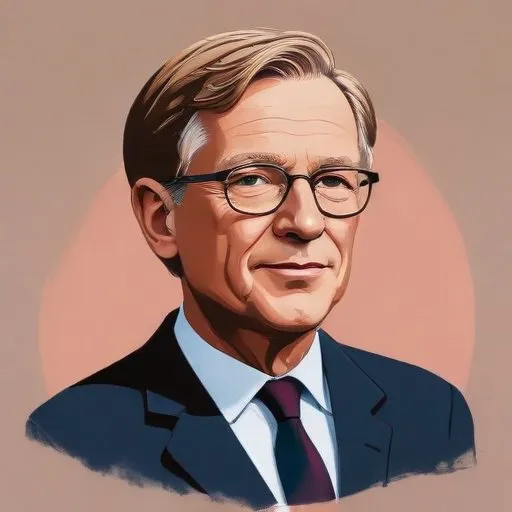
A Dutch journalist, economist, and politician who served as Deputy Prime Minister of the Netherlands, known for his progressive policies and efforts to reduce economic inequality. He played a key role in shaping the country's social and economic landscape.
Joop den Uyl, a Dutch politician and economist, is renowned for his remarkable tenure as Prime Minister of the Netherlands from 1973 to 1977. During his time in office, he implemented numerous progressive reforms, solidifying his legacy as a champion of social justice and equality.
Born on August 9, 1919, in Hilversum, Netherlands, Joop den Uyl pursued his academic interests at the University of Amsterdam, earning a Master of Economics degree. This strong educational foundation laid the groundwork for his future success in politics and economics.
Den Uyl's professional journey began as a civil servant at the Ministry of Economic Affairs from 1942 to 1945. He then transitioned to journalism, working as an editor for Het Parool and Vrij Nederland from 1945 to 1949. This experience honed his communication skills, allowing him to effectively convey his vision to the masses.
As director of the Wiardi Beckman Foundation from 1949 to 1963, Den Uyl actively contributed to the Labour Party's (PvdA) think tank, further solidifying his position within the party.
In 1956, Den Uyl became a Member of the House of Representatives, where he served as a frontbencher and spokesperson for Economics. His dedication to the party led to his appointment as Minister of Economic Affairs in the Cals Cabinet in 1965.
After Labour Leader Anne Vondeling stepped down, Den Uyl succeeded him as the party leader in 1966. He went on to lead the party in several elections, eventually becoming Prime Minister of the Netherlands in 1973.
During his tenure as Prime Minister, Den Uyl introduced a range of reforms, including the introduction of a minimum wage, increased social security benefits, and the implementation of a progressive tax system. His administration also focused on addressing environmental concerns and improving infrastructure.
Although his cabinet collapsed in 1977, Den Uyl's legacy as a champion of social justice and equality endures. His commitment to progressive values continues to inspire future generations of politicians and policymakers.
"A society that is just and fair is not a utopia, but a necessity." - Joop den Uyl
This poignant quote encapsulates Den Uyl's unwavering commitment to creating a more equitable society, a vision that continues to resonate with people today.
Den Uyl's tenure as Prime Minister marked a significant period of social and political change in the Netherlands. His reforms and policies had a lasting impact on the country's social and economic landscape.
As a comparative analysis with contemporaries, Den Uyl's commitment to social justice and equality sets him apart as a visionary leader, one who continues to inspire future generations of politicians and policymakers.
Joop den Uyl's remarkable life and legacy serve as a testament to the power of progressive values and the importance of fighting for social justice and equality.
88 Years Old
Led the Netherlands as Prime Minister from 1994 to 2002, implementing significant economic reforms and guiding the country's integration into the European Union. He's also known for his role in shaping the country's social and economic policies.
87 Years Old
The Prime Minister of the Netherlands from 1982 to 1994, known for leading the country through a period of economic growth and implementing significant welfare state reforms. He also served as the United Nations High Commissioner for Refugees from 2001 to 2005.
95 Years Old
A Dutch statesman who served as Prime Minister of the Netherlands from 1977 to 1982, known for his progressive policies and European integration efforts.
95 Years Old
A Dutch journalist and politician who served as Deputy Prime Minister of the Netherlands, known for his progressive views and leadership in the Democrats 66 party. He played a key role in shaping the country's social and economic policies.
Born in 1903
A Dutch economist and academic who developed the first national economic model and was awarded the first Nobel Prize in Economics in 1969 for his work on econometrics.
