


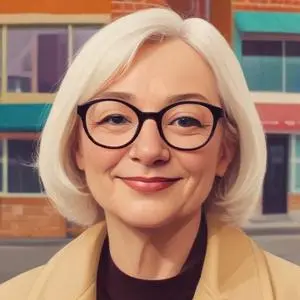
A pioneering urban studies activist who challenged conventional urban planning wisdom, advocating for diverse, vibrant, and people-centered city design.
Jane Jacobs is renowned for her groundbreaking work in challenging conventional urban planning policies, advocating for a people-centric approach to city development. Her magnum opus, "The Death and Life of Great American Cities" (1961), sparked a paradigm shift in urban studies, sociology, and economics, earning her the title of "the mother of modern urbanism."
Jane Isabel Butzner was born on May 4, 1916, in Scranton, Pennsylvania, to a Protestant family. Her father, John Decker Butzner, was a physician, and her mother, Bess Robison Butzner, was a former teacher and nurse. After graduating from Scranton High School, Jacobs worked as an unpaid assistant to the women's page editor at the Scranton Tribune.
Jacobs' lack of formal training in urban planning didn't deter her from questioning the wisdom of established experts. She criticized urban renewal and slum clearance policies, arguing that they disregarded the needs of city dwellers. Her grassroots activism prompted her to organize campaigns against Robert Moses' plans to overhaul her beloved Greenwich Village neighborhood.
Jacobs played a pivotal role in the cancellation of the Lower Manhattan Expressway, which would have ravaged SoHo, Little Italy, and Chinatown. Her fervent advocacy led to her arrest in 1968 for inciting a crowd at a public hearing on the project.
After relocating to Toronto in 1968, Jacobs joined forces with local activists to oppose the Spadina Expressway and the associated network of expressways. Her tireless efforts yielded success, as the projects were eventually cancelled.
As a woman and a writer in a male-dominated field, Jacobs faced scorn and criticism. Despite the lack of formal credentials, she persisted in challenging the established norms. Her work eventually earned recognition from esteemed professionals like Richard Florida and Robert Lucas.
Jacobs' philosophy centered around the importance of human scale, diversity, and community engagement in urban planning. She advocated for mixed-use development, walkable neighborhoods, and the preservation of historic districts.
Jacobs' influence extends beyond the realm of urban planning. Her ideas have shaped modern sociology, economics, and environmental studies. Her legacy continues to inspire new generations of urban activists, policymakers, and community leaders.
"Cities have the capability of providing something for everybody, only because, and only when, they are created by everybody."
Jane Jacobs' remarkable story serves as a testament to the power of conviction, perseverance, and community engagement. Her work continues to inspire a more inclusive, human-centric approach to urban planning, leaving an indelible mark on modern society.
Born in 1888
A visionary urban planner who reshaped New York City's landscape with massive infrastructure projects, including highways, bridges, and public parks. His work transformed the city's dynamics and influenced urban development worldwide.
Born in 1895
A renowned thinker who explored the intersection of technology, culture, and human values, shedding light on the consequences of urbanization and the importance of balancing progress with humanity. 42
Born in 1907
A French-American historian and author who wrote extensively on Western culture, history, and education, and is particularly renowned for his comprehensive and insightful works on the development of Western civilization.
Born in 1867
Visionary architect behind iconic, harmonious structures that blend seamlessly into their surroundings, redefining modern American architecture.
Born in 1887
A pioneer of modern architecture, famous for designing innovative, functional, and visually striking buildings that transformed urban landscapes. His works continue to inspire architects and designers worldwide.
Born in 1846
Designed the iconic World's Columbian Exposition in Chicago, showcasing innovative neoclassical architecture that influenced urban planning and design. This visionary's work continues to inspire modern cityscapes.
Born in 1822
Co-designer of iconic public spaces, including Central Park, revolutionizing urban landscape architecture. Known for harmoniously blending nature and urban development.
