


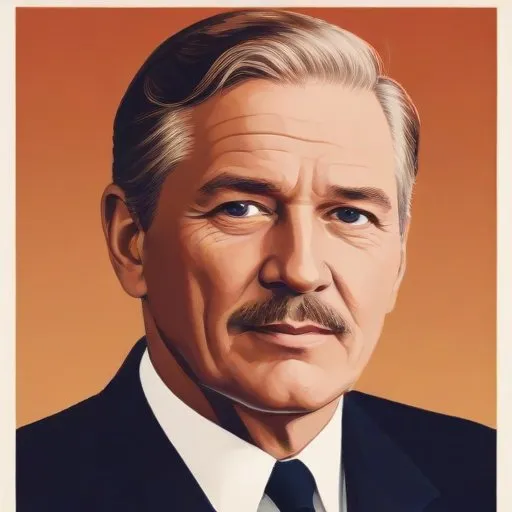
Engineer and politician who governed the Panama Canal Zone, overseeing its construction and development. He played a crucial role in the canal's operation and expansion.
Jay Johnson Morrow was a distinguished American military engineer, statesman, and diplomat who played a pivotal role in shaping the nation's infrastructure and foreign policy during the early 20th century. As Chief Engineer of the United States First Army and Deputy Chief Engineer of the American Expeditionary Force during World War I, Morrow's leadership and expertise were instrumental in the Allied victory.
Born on February 20, 1870, in Fairview, West Virginia, Morrow was of Scots-Irish descent. He was the brother of U.S. Senator and Diplomat Dwight Morrow and uncle of Anne Morrow Lindbergh, the legendary aviator and author.
Morrow graduated from the United States Military Academy at West Point in 1891 and was commissioned in the U.S. Army Corps of Engineers. He served as an instructor in military engineering at West Point from 1895 to 1896 and later as military governor of the Philippine Province of Zamboanga from 1901 to 1902.
Morrow's military career was marked by several notable appointments, including Engineering Commissioner in the District of Columbia from 1907 to 1909. During World War I, he served as Chief Engineer of First Army and as Deputy Chief Engineer of the American Expeditionary Force, playing a crucial role in the war effort.
In 1921, Morrow was appointed Governor of the Panama Canal Zone, a position he held until 1924. During his tenure, he oversaw the construction of the Panama Canal, a monumental engineering feat that revolutionized global trade and commerce.
Morrow married Harriet McMullen Butler on October 15, 1895, and the couple resided in Englewood, New Jersey. Harriet died in 1935, and Morrow passed away on April 16, 1937. His ashes were scattered over the Chagres River, which feeds into the Panama Canal, in a poignant tribute to his legacy.
Jay Johnson Morrow's remarkable career was marked by his unwavering dedication to public service, his outstanding leadership, and his vision for a stronger, more connected world. As a testament to his enduring legacy, Morrow'sname remains synonymous with excellence in military engineering, diplomacy, and statesmanship.
Born in 1858
A pioneering leader who championed progressive reforms, trust-busting, and conservation, earning a Nobel Peace Prize for mediating the Russo-Japanese War. He's also famous for his rugged outdoorsmanship and "big stick" diplomacy.
Born in 1857
The 27th President of the United States was a lawyer and jurist who served as the only person to hold the offices of President and Chief Justice of the United States. He's known for his significant contributions to the country's judicial system.
Born in 1856
The 28th President of the United States, a Nobel Peace Prize winner, and a historian who played a key role in shaping international relations and global governance after World War I. He's most known for his idealistic vision of a League of Nations and his efforts to promote peace and diplomacy.
Born in 1865
The 29th President of the United States, a journalist-turned-politician, led the country through a period of post-war prosperity and scandalous corruption. He's infamous for his administration's numerous scandals and his own extramarital affairs.
Born in 1872
The 30th President of the United States, a lawyer and politician, led the country through a period of economic prosperity and limited government intervention, earning the nickname "Silent Cal" for his frugal and humble nature. He's most known for his minimalist approach to governance and tax cuts.
Born in 1874
The 31st President of the United States was a humanitarian and politician who led the country through the Great Depression and is known for his humanitarian efforts and infrastructure development. He's also infamous for his inability to mitigate the economic crisis.
Born in 1882
Led the United States through the Great Depression and World War II, implementing a series of reforms known as the New Deal and helping to establish the country as a global superpower.
Born in 1884
The 33rd President of the United States, a strong leader who made tough decisions, including dropping atomic bombs on Japan and establishing the Marshall Plan to rebuild Europe after WWII.
