


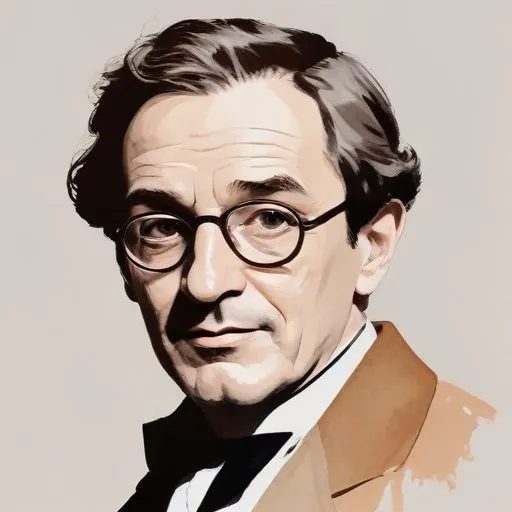
A renowned French playwright and screenwriter, known for his poignant and thought-provoking works that often explored the human condition, morality, and the absurdity of life.
Jean Anouilh was a renowned French dramatist and screenwriter, best known for his iconic play Antigone, an adaptation of Sophocles' classical drama, which was seen as a bold attack on Marshal Pétain's Vichy government. With a career spanning five decades, Anouilh's work ranged from high drama to absurdist farce, earning him a reputation as one of France's most prolific and celebrated writers.
Anouilh was born on June 23, 1910, in Cérisole, a small village on the outskirts of Bordeaux, France, to a family of Basque ancestry. His father, François Anouilh, was a tailor, and Anouilh often credited him with instilling a pride in conscientious craftsmanship. His mother, Marie-Magdeleine, was a violinist who played in the casino orchestra in the nearby seaside resort of Arcachon, exposing Anouilh to the world of performing arts from a young age.
Anouilh's first foray into playwriting began at the age of 12, although his early works do not survive. He would often attend rehearsals and solicit script readings from resident authors, absorbing the dramatic performances from backstage. This early exposure laid the foundation for his future success as a playwright.
Anouilh's breakthrough came with his play Antigone, which premiered in 1944 and solidified his reputation as a powerful and provocative writer. Other notable works include The Lark, Ring Round the Moon, and The Waltz of the Toreadors, which showcased his mastery of both drama and comedy.
Anouilh's work often grappled with themes of maintaining integrity in a world of moral compromise, reflecting his own strong sense of conviction and commitment to artistic honesty. His plays often explored the human condition, delving into the complexities of love, politics, and morality.
Anouilh's plays have had a profound impact on modern society, inspiring generations of writers and artists. His work has been translated into numerous languages and continues to be performed worldwide, solidifying his legacy as one of the most important dramatists of the 20th century.
In 1918, Anouilh's family moved to Paris, where he received his secondary education at the Lycée Chaptal. He earned acceptance into the law school at the Sorbonne but ultimately abandoned his studies due to financial constraints. Despite these early setbacks, Anouilh went on to forge a remarkable career, earning numerous awards and accolades for his contributions to French literature.
"I have always tried to live in an ivory tower, but a flood cannot be stopped by an ivory tower." - Jean Anouilh
"The drama is complete poetry. It is a complete fiction. It is the fiction of the human being, and it is the fiction of the universe." - Jean Anouilh
Anouilh's work was often compared to that of his contemporaries, such as Jean-Paul Sartre and Albert Camus, who were also grappling with existentialist and absurdist themes. However, Anouilh's unique approach, which blended traditional storytelling with modernist experimentation, set him apart from his peers.
Today, Anouilh's plays continue to be performed and studied around the world, inspiring new generations of writers, directors, and actors. His legacy as a master playwright and screenwriter remains unrivaled, cementing his place as one of the most important cultural figures of the 20th century.
Born in 1900
A pioneering aviator and writer, known for his poetic and philosophical novels, particularly "The Little Prince", which has become a timeless classic of world literature.
Born in 1905
Existentialist philosopher and playwright who argued that humans have complete freedom to choose their actions and create their own meaning in life, influencing modern thought on morality and individual responsibility.
Born in 1913
A French novelist, philosopher, and journalist who wrote influential works like "The Stranger" and "The Plague", exploring absurdism and the human condition.
Born in 1889
A renowned French creative force, celebrated for his innovative and surreal works that blurred the lines between literature, art, and cinema, leaving an indelible mark on 20th-century culture.
Born in 1869
A French literary giant, renowned for his novels and essays that explored the human condition, morality, and the search for authenticity. His works often blurred the lines between fiction and autobiography.
91 Years Old
A celebrated French literary figure, known for her provocative and introspective works that explored the human condition, particularly among the young and disillusioned. Her writing often blended wit, sophistication, and emotional depth.
Born in 1897
A leading figure of the French Resistance during WWII, he wrote influential poetry and novels that explored the human condition, blending politics and art.
Born in 1882
A French literary mastermind behind iconic plays like "The Madwoman of Chaillot" and novels that blend fantasy and social commentary, known for his witty, poetic, and thought-provoking style.
