


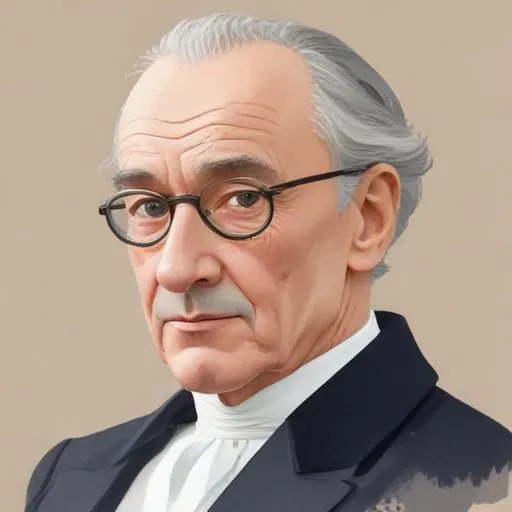
A French literary mastermind behind iconic plays like "The Madwoman of Chaillot" and novels that blend fantasy and social commentary, known for his witty, poetic, and thought-provoking style.
Renowned for his poetic fantasy and stylistic elegance, Jean Giraudoux is considered one of the most important French dramatists of the interwar period, captivating audiences with his nuanced exploration of the human experience. His work delves into the intricate relationships between men and women, as well as the unattainable ideals that drive human behavior.
Born on October 29, 1882, in Bellac, Haute-Vienne, Giraudoux was immersed in the world of literature and politics from a young age. His father, Léger Giraudoux, worked for the Ministry of Transport, and his exposure to the world of bureaucracy would later influence his writing. Giraudoux's education at the Lyce Lakanal in Sceaux and his subsequent travels throughout Europe broadened his perspectives and fueled his creativity.
In 1910, Giraudoux accepted a position with the Ministry of Foreign Affairs, marking the beginning of his diplomatic career. However, with the outbreak of World War I, he was called to serve, earning distinction and becoming the first writer to receive the wartime Legion of Honour in 1915. His experiences during the war would later influence his writing, imbuing it with a sense of humanity and gravitas.
Giraudoux's literary career took off in the 1920s, with the publication of novels such as Siegfried et le Limousin (1922) and Eglantine (1927). His collaboration with actor and theatre director Louis Jouvet, beginning in 1928, revolutionized his writing, leading to the creation of plays that would solidify his international reputation.
Giraudoux's work transcended linguistic and cultural boundaries, earning him recognition in the English-speaking world. His plays were adapted by notable writers such as Christopher Fry (Tiger at the Gates) and Maurice Valency (The Madwoman of Chaillot, Ondine, The Enchanted, and The Apollo of Bellac). These adaptations introduced his work to new audiences, cementing his status as a master of French theatre.
Aside from his literary pursuits, Giraudoux was committed to supporting the arts and humanities. He served as a juror for the Prix Blumenthal, a grant awarded to painters, sculptors, decorators, engravers, writers, and musicians between 1919 and 1954. In politics, he was affiliated with the Radical Party, serving in the cabinet of Édouard Herriot in 1932 and later as Minister of Information under Édouard Daladier.
Through his work, Giraudoux left an indelible mark on French theatre, exploring the intricacies of human relationships and the poetic potential of language. His writing continues to inspire new generations of writers, directors, and actors, solidifying his position as a luminary of 20th-century French literature.
These words of wisdom offer a glimpse into Giraudoux's profound understanding of the human experience, echoing the themes that permeate his literary works.
Jean Giraudoux's life and work serve as a testament to the power of art to capture the essence of humanity. His elegant prose, nuanced characters, and philosophical explorations continue to captivate audiences, ensuring that his legacy will endure for generations to come.
Born in 1869
A French literary giant, renowned for his novels and essays that explored the human condition, morality, and the search for authenticity. His works often blurred the lines between fiction and autobiography.
Born in 1905
Existentialist philosopher and playwright who argued that humans have complete freedom to choose their actions and create their own meaning in life, influencing modern thought on morality and individual responsibility.
Born in 1913
A French novelist, philosopher, and journalist who wrote influential works like "The Stranger" and "The Plague", exploring absurdism and the human condition.
91 Years Old
A celebrated French literary figure, known for her provocative and introspective works that explored the human condition, particularly among the young and disillusioned. Her writing often blended wit, sophistication, and emotional depth.
Born in 1908
A pioneering feminist philosopher who wrote extensively on ethics, politics, and gender, famously arguing that "one is not born, but rather becomes, a woman."
Born in 1910
A renowned French playwright and screenwriter, known for his poignant and thought-provoking works that often explored the human condition, morality, and the absurdity of life.
Born in 1889
A Chilean poet and educator who was the first Latin American to win the Nobel Prize in Literature, known for her passionate and introspective poetry that explores themes of love, nature, and social justice.
Born in 1869
A pioneering artist who revolutionized modern art with bold, expressive, and colorful works that blurred the lines between painting and sculpture, creating a new language of form and color.
