


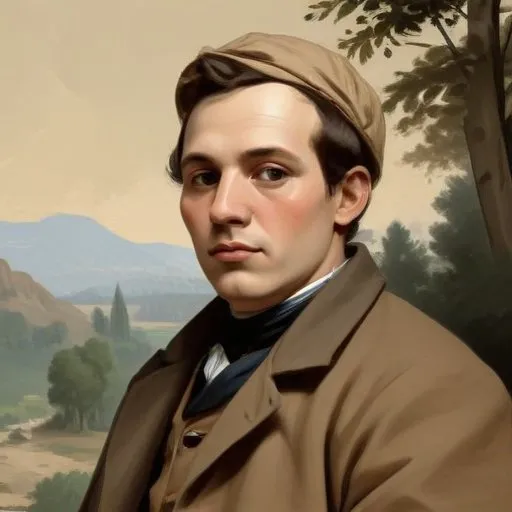
A French painter and etcher, renowned for capturing the essence of landscapes and figures with a unique blend of realism and romanticism, creating dreamy, ethereal scenes.
Jean-Baptiste-Camille Corot, simply known as Camille Corot, is revered as one of the most influential landscape painters of all time, bridging the gap between Neoclassicism and Impressionism. With a vast output of over 3,000 paintings, Corot's work revolutionized the art world, earning him the title "the father of landscape painting."
Born on July 16, 1796, in Paris, Corot grew up in a family of modest means, with his father working as a wig maker and his mother as a milliner. Despite his family's financial stability, Corot's academic record was unremarkable, and he showed no inclination towards art until much later in life.
After struggling in school, Corot was sent to a boarding school, where he developed a passion for nature and the outdoors. It was during this period that he made his first paintings, inspired by his surroundings. These early works laid the foundation for his future career as a landscape painter.
Corot's artistic journey began in earnest when he traveled to Italy in 1825, where he was heavily influenced by the works of Claude Lorraine and Nicolas Poussin. Upon his return to France, he dedicated himself to landscape painting, producing works that were both poetic and realistic.
Corot's unique style, characterized by soft, feathery brushstrokes and a focus on light and atmosphere, earned him critical acclaim. He was one of the first artists to explore the concept of "open air" painting, experimenting with the effects of natural light on his subjects.
Some of Corot's most notable works include:
Corot's innovative approach to landscape painting had a profound impact on the development of Impressionism, influencing artists such as Claude Monet, Pierre-Auguste Renoir, and Camille Pissarro. His emphasis on capturing light and atmosphere paved the way for the Impressionist movement, which transformed the art world in the late 19th century.
Corot remained a humble and private individual throughout his life, preferring to focus on his art rather than seeking fame or fortune. He died on February 22, 1875, leaving behind a legacy that continues to inspire artists and art lovers to this day.
Corot's work can be found in museums and private collections around the world, a testament to his enduring influence on the art world.
"The most important things in life are the people you love, what you do, and how you see the world." - Camille Corot
This quote encapsulates Corot's philosophy, highlighting the importance of relationships, passion, and perspective in shaping one's life and art.
Corot was awarded the Legion of Honor in 1846, a prestigious recognition of his contribution to the arts.
In conclusion, Jean-Baptiste-Camille Corot was a trailblazing artist who left an indelible mark on the art world. His innovative approach to landscape painting, his dedication to capturing the beauty of nature, and his influence on generations of artists make him a true treasure of French art.
Born in 1840
A founder of Impressionism, capturing fleeting light and color in dreamy landscapes and water scenes, revolutionizing modern art.
Born in 1841
A pioneer of Impressionism, creating vibrant, intimate portraits and landscapes that capture the beauty of everyday life. His works evoke a sense of joy and warmth, celebrating the human experience.
Born in 1830
A Danish-French Impressionist painter who captured the beauty of landscapes and cityscapes with vivid colors and bold brushstrokes, influencing the development of modern art.
Born in 1839
A landscape painter who captured the essence of rural France and England through his Impressionist works, often focusing on the fleeting effects of light and atmosphere.
Born in 1776
A Romantic-era painter celebrated for capturing the essence of the English countryside through serene, naturalistic landscapes, often featuring skies and clouds.
Born in 1798
A Romantic-era master of expressive brushstrokes and vivid color, creating iconic works that captured the drama and emotion of historical and literary scenes.
