


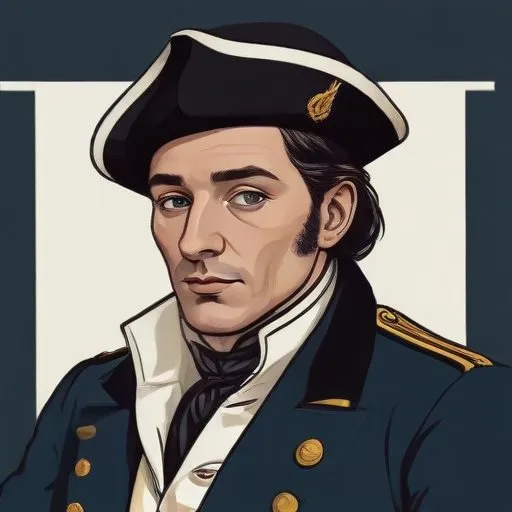
French sailor, explorer, and politician who led an expedition to the South Atlantic, discovering Bouvet Island, and later became the Governor of Mauritius. He played a significant role in French colonial history.
Jean-Baptiste Charles Bouvet de Lozier was a French sailor, explorer, and governor of the Mascarene Islands, best known for discovering Bouvet Island, the world's remotest island, on January 1, 1739. This tiny island, located in the South Atlantic, was named after him, but little did he know that his coordinates would be mislabeled, causing it to be lost for nearly seven decades until its rediscovery in 1808.
Bouvet de Lozier was born on January 14, 1705. Orphaned at the age of seven, he was educated in Paris and later sent to Saint Malo to study navigation. His early life was marked by determination and perseverance, traits that would serve him well in his future expeditions.
In 1731, Bouvet de Lozier became a lieutenant of the French East India Company, and his success in convincing his employer to provide him with two ships, the Aigle and Marie, led to his historic expedition in the South Atlantic. Despite the challenges he faced, including illness among his crew, he successfully discovered Bouvet Island, a feat that would make him a legend in the world of exploration.
Ten years after his expedition, Bouvet de Lozier was appointed governor of the Mascarene Islands, a position he held twice, from 1750 to 1752 and again from 1757 to 1763. During his tenure, he demonstrated his administrative skills, solidifying his reputation as a capable leader.
Despite the initial loss of Bouvet Island's coordinates, Bouvet de Lozier's discovery marked a significant milestone in the history of exploration. His bravery, determination, and perseverance have inspired generations of sailors, explorers, and scientists. Today, Bouvet Island remains a remote and inhospitable place, but its discovery stands as a testament to human curiosity and the unrelenting pursuit of knowledge.
Born in 1567
French explorer who mapped much of eastern North America, establishing trade and settlement in what is now Canada and the northeastern United States.
Born in 1491
French navigator and explorer who led three expeditions to North America, mapping the Gulf of St. Lawrence and claiming the region for France. He's also credited with introducing Europeans to the concept of tobacco.
