


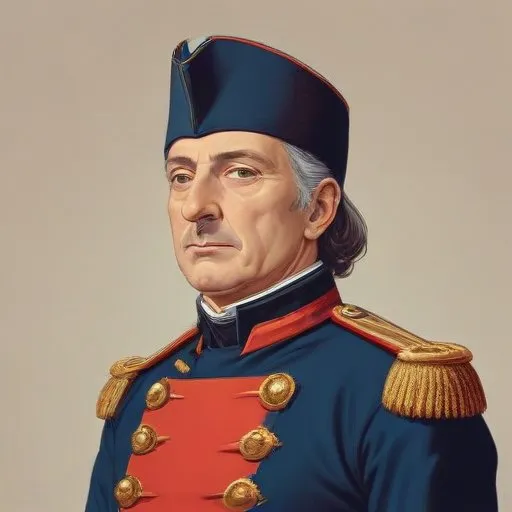
A pioneering general and engineer who developed the first tanks and revolutionized modern warfare. He's credited with creating the first armored divisions and transforming the face of battle.
General Jean Baptiste Eugne Estienne is renowned as the pioneer of modern French artillery and military aviation, earning the esteemed title "Pre des Chars" or "Father of the Tank". His groundbreaking contributions revolutionized the face of warfare, leaving an indelible mark on the development of military technology.
Born on November 7, 1860, in Conden-Barrois, Meuse, Estienne was admitted to the prestigious cole Polytechnique at the tender age of nineteen. He graduated 131st in his year in 1882, the same year he won first prize in the national mathematics competition. This knack for mathematics and philosophical problems laid the foundation for his future accomplishments.
Estienne joined the French army as a second lieutenant in 1883, serving with the artillery from 1884. His research on ballistics led to the presentation of his seminal work, "Erreurs d'Observation", to the Acadmie des Sciences in 1890. This work stimulated the introduction of modern indirect fire methods, cementing his reputation as a visionary in the field.
As he rose through the ranks, Estienne continued to develop telemetric instruments at the Bourges arsenal, applying his theories to real-world problems. He became squadron commander with the 19th Artillery Regiment in 1902 and later headed the workshop building precision instruments for the technical artillery section in Paris. During this period, he promoted the use of telephonic connections to enable the artillery to switch targets quickly, demonstrating his commitment to innovation.
Estienne's expertise extended beyond artillery to military aviation. As one of the founders of the French aviation service at Reims, he played a crucial role in shaping the nation's military aviation capabilities. His work in this field solidified his position as one of the most competent and progressive officers in France.
General Estienne's groundbreaking work has had a lasting impact on modern warfare. His development of the French tank arm has influenced military strategy and tactics worldwide. He is remembered as a pioneer, a true original who dared to challenge conventional thinking and push the boundaries of what was thought possible.
Estienne's fascination with Greek Antiquity and mathematical problems reveals a deeper philosophical undercurrent to his work. His passion for problem-solving and innovation reflects a commitment to pushing the boundaries of human knowledge and understanding.
The impact of Estienne's work extends far beyond the realm of military technology. His contributions have shaped the modern world, influencing the development of tanks, artillery, and military aviation. His legacy serves as a testament to the power of human ingenuity and innovation.
Born in 1856
A French general who led the country to defeat in World War II and later collaborated with the Nazis, serving as the Chief of State of Vichy France. He's infamous for his role in the French surrender and subsequent authoritarian regime.
Born in 1890
A French military leader who led the Free French Forces during WWII and later became President of France, known for his strong leadership and vision for a unified Europe.
Born in 1841
A French journalist, physician, and politician who served as Prime Minister of France during World War I, leading the country to victory and playing a key role in shaping the Treaty of Versailles. He's also known for his strong leadership and witty humor.
Born in 1851
A French field marshal who played a crucial role in World War I, leading the Allied forces to victory and earning the title "The Tiger" for his tenacity and strategic genius. He's also known for his post-war efforts to maintain peace and stability in Europe.
Born in 1854
A French general and politician who played a key role in shaping France's colonial empire and served as Minister of War during World War I, known for his military campaigns in North Africa.
Born in 1856
A renowned military leader who commanded the Allied Army of the Orient during World War I, earning the nickname "Desperate Frankie" for his bold tactics. He played a crucial role in the Allied victory on the Macedonian Front.
