


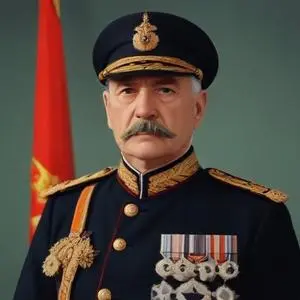
A French field marshal who played a crucial role in World War I, leading the Allied forces to victory and earning the title "The Tiger" for his tenacity and strategic genius. He's also known for his post-war efforts to maintain peace and stability in Europe.
Marshal Ferdinand Foch is renowned for his exceptional military prowess and strategic brilliance, which played a pivotal role in the Allied victory during World War I. As the Supreme Allied Commander on the Western Front, Foch masterminded a series of crucial battles that thwarted the German advance and paved the way for the Allied triumph.
Born on October 2, 1851, in Tarbes, France, Foch came from a family of modest means. Despite the financial constraints, his parents encouraged his academic pursuits, and Foch went on to study at the École Polytechnique and later at the Staff College. His dedication and perseverance earned him rapid promotions in the French Army, and by the outbreak of World War I, he had risen to the rank of General.
Foch's military acumen was evident from the early stages of the war. He commanded the XX Corps during the invasion of Germany in 1914 and later played a crucial role in the First Battle of the Marne, which halted the German advance on Paris. His success in this battle earned him widespread recognition, and he was subsequently promoted to Assistant Commander-in-Chief for the Northern Zone.
However, it was during the German spring offensive of 1918 that Foch's strategic genius truly came to the fore. As the Supreme Allied Commander, he coordinated the efforts of the French, British, and American forces, exploiting the German army's weaknesses and launching a series of decisive counterattacks. The outcome was a resounding Allied victory, which paved the way for the Armistice of November 11, 1918.
Foch's military philosophy was rooted in his belief in the importance of strategic reserves and the need for adaptability on the battlefield. He was a proponent of the "methodical battle," which emphasized the careful planning and execution of military operations. Foch's approach was characterized by a deep understanding of the psychological and tactical aspects of warfare, which earned him the respect of his peers and the admiration of his troops.
Foch's achievements during World War I earned him numerous accolades, including the prestigious Marshal of France title, which was bestowed upon him in 1918. He was also awarded the Grand Cross of the Legion of Honor and was elected to the French Academy in 1918.
Foch's contribution to the Allied victory in World War I cannot be overstated. His leadership and strategic acumen played a crucial role in shaping the course of the war and ultimately securing the Allied triumph. As a result, he remains one of the most celebrated military leaders in French history, and his legacy continues to inspire military strategists and historians alike.
Through his remarkable military career and leadership during World War I, Ferdinand Foch left an indelible mark on history, cementing his place as one of the most illustrious generals of the modern era.
Born in 1856
A French general who led the country to defeat in World War II and later collaborated with the Nazis, serving as the Chief of State of Vichy France. He's infamous for his role in the French surrender and subsequent authoritarian regime.
Born in 1841
A French journalist, physician, and politician who served as Prime Minister of France during World War I, leading the country to victory and playing a key role in shaping the Treaty of Versailles. He's also known for his strong leadership and witty humor.
Born in 1863
A Welsh lawyer and politician who served as Prime Minister of the United Kingdom, leading the country through World War I and introducing key social reforms. He's known for his charismatic leadership and progressive policies.
Born in 1856
The 28th President of the United States, a Nobel Peace Prize winner, and a historian who played a key role in shaping international relations and global governance after World War I. He's most known for his idealistic vision of a League of Nations and his efforts to promote peace and diplomacy.
Born in 1847
A German field marshal and politician who served as the 2nd President of Germany during the Weimar Republic, playing a crucial role in the rise of the Nazi Party. He's infamous for appointing Adolf Hitler as Chancellor of Germany in 1933.
