


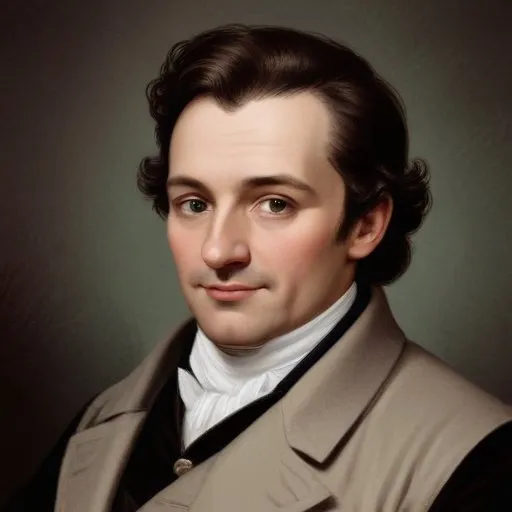
A French mathematician and astronomer who calculated the arc of the meridian, providing a precise measurement of the Earth's circumference, and developed the metric system. He also made significant contributions to astronomy, including the discovery of two asteroids.
Jean Baptiste Joseph Delambre was a French mathematician, astronomer, historian of astronomy, and geodesist who made significant contributions to the field of measurement. He is best known for his work on the definition of the meter, a unit of measurement that would become a cornerstone of modern science.
Delambre was born on September 19, 1749, in Amiens, France. A childhood fever left him with sensitive eyes, which led him to develop an exceptional memory to compensate for his limited reading ability. This unique skill allowed him to devour books in various languages, including Greek, Latin, Italian, English, and German.
Delambre's career in astronomy flourished quickly, and in 1788, he was elected a foreign member of the Royal Swedish Academy of Sciences. His expertise in astronomy and mathematics made him an ideal candidate to work on the definition of the meter.
In 1790, the National Constituent Assembly tasked the French Academy of Sciences with introducing a new unit of measurement. The academy decided on the meter, defined as one ten-millionth of the distance from the North Pole to the equator. To establish this unit, Delambre was part of an expedition to measure the length of the meridian arc between Dunkirk and Barcelona.
In April 1791, the academy's Metric Commission chose Delambre, along with Jean-Dominique de Cassini, Adrien-Marie Legendre, and Pierre Méchain, to undertake the mission. After Cassini refused to serve under the revolutionary government, Delambre was elected unanimously to head the northern expedition.
Delambre's work on the definition of the meter led to the publication of his book,
Delambre's contributions to astronomy and mathematics earned him recognition as a foreign member of several scientific academies, including the Royal Swedish Academy of Sciences and the Royal Society of London.
Delambre's work on the definition of the meter had a profound impact on modern science. The meter became a standard unit of measurement, allowing scientists to make precise calculations and comparisons across different fields. Today, the meter is used in countless applications, from physics and chemistry to engineering and everyday commerce.
Delambre's legacy extends beyond his scientific contributions. He was a prolific writer and historian, and his books on the history of astronomy remain valuable resources for scholars today.
Delambre was appointed director of the Paris Observatory in 1804, a position he held until his death in 1822. He was also elected to the French Academy of Sciences in 1792 and served as its president from 1814 to 1815.
Delambre's remarkable life was marked by his extraordinary memory, his passion for learning, and his significant contributions to science. He died on August 19, 1822, leaving behind a legacy that continues to inspire and influence scientists to this day.
Born in 1749
Developed nebular hypothesis of the origin of the solar system and formulated Laplace's equation, a fundamental concept in mathematics and physics. He's considered the founder of celestial mechanics.
Born in 1752
Developed the theory of elliptic integrals, and his work on number theory laid the foundation for modern cryptography.
Born in 1736
Developed calculus, number theory, and celestial mechanics, making significant contributions to the fields of mathematics and astronomy.
Born in 1777
A pioneer in mathematics and physics, he made major contributions to number theory, algebra, and electromagnetism, shaping our understanding of the natural world.
Born in 1852
A German mathematician and academic who proved that pi is a transcendental number, resolving a centuries-old problem and laying the foundation for modern number theory.
Born in 1854
A pioneer in mathematics and physics, he laid the foundations for modern chaos theory, topology, and relativity, making groundbreaking contributions to our understanding of space and time.
Born in 1871
A French mathematician and politician who made significant contributions to probability theory, measure theory, and topology, and served as a minister in the French government.
Born in 1865
A pioneer in number theory, developed the prime number theorem, and contributed significantly to the development of mathematics, particularly in the fields of differential equations and functional analysis.
