


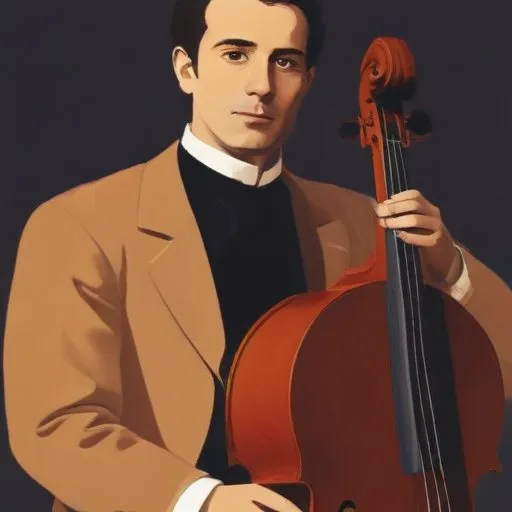
An 18th-century virtuoso cellist and composer, renowned for his technical innovations and expressive playing style that elevated the cello to a solo instrument. His music still inspires cellists today.
JeanBaptiste Stuck, also known as Baptistin, Batistin, or Battistin, was a renowned Italian-French composer and cellist of the Baroque era, celebrated for his extraordinary contributions to the world of opera and classical music. Born on May 6, 1680, in Livorno, Tuscany, Stuck left an indelible mark on the music landscape, earning him a revered place among the greatest composers of his time.
Little is known about Stuck's early years, but it is recorded that he was born into a merchant family, the son of Giovanni Giacomo Stuck and Barbera Hellerbeck. His early life took a significant turn in 1702 when he entered the service of Countess Lemos in Naples. This marked the beginning of his illustrious career, which would take him to the heights of success in Paris.
In 1705, Stuck published his collection "Fr das Jahr 1701" through the prestigious Ballard publishing house, solidifying his reputation as a composer of note. His talent and skill soon caught the attention of the French aristocracy, and he became a member of the Chapelle royale and a cellist in the service of Philippe II, Duke of Orléans.
Stuck's innovative spirit led him to introduce the cello as a leading instrument in the opera orchestra, displacing the bass viol in 1722. This bold move revolutionized the sound of classical music, paving the way for future generations of composers and musicians.
Stuck composed numerous operas, including "Mlagre" (1709), "Manto la fe" (1710), "Il Gran Cid" (1715), and "Polydore" (1720). These works showcased his mastery of the genre, blending drama, music, and spectacle to captivate audiences.
Stuck's prolific output also included four books of cantatas, published between 1706 and 1714. These collections, titled "Cantates Franoises" and "Cantates Franoises et Italienne", featured works for solo voice, with and without symphonies, showcasing his expertise in the genre.
Throughout his life, Stuck worked tirelessly to promote French and Italian music, bridging the cultural divide between the two nations. His legacy extends far beyond his own lifetime, influencing generations of composers, musicians, and music lovers. In 1733, he was naturalized French, a testament to his profound impact on the French classical music scene.
Stuck's life was marked by significant milestones, including his naturalization as a French citizen in 1733. He died on December 8, 1755, in Paris, leaving behind a rich cultural heritage that continues to inspire and delight audiences today.
JeanBaptiste Stuck's remarkable life and career serve as a testament to his boundless talent, innovative spirit, and dedication to his craft. As a composer, cellist, and cultural ambassador, he left an indelible mark on the world of classical music, ensuring his legacy will continue to inspire and delight audiences for generations to come.
Born in 1770
A musical genius who expanded the possibilities of classical music, creating iconic symphonies and piano sonatas that continue to inspire and influence generations of artists.
Born in 1782
A virtuosic violinist and composer who revolutionized the instrument's technical possibilities, leaving an indelible mark on classical music.
Born in 1811
A virtuosic pianist and composer who revolutionized classical music with his technically demanding and emotionally expressive works, blending Hungarian folk influences with Romantic-era drama.
Born in 1809
A renowned 19th-century musician who masterfully blended classical and romantic styles, creating iconic works like the "Wedding March" and "Elijah" oratorio. His compositions continue to inspire and influence generations of artists.
Born in 1833
A renowned pianist and composer, he crafted complex, expressive works that blended traditional and innovative techniques, leaving an indelible mark on classical music.
Born in 1678
A virtuosic violinist and prolific composer, he crafted over 400 concertos, including "The Four Seasons," which remains a beloved and iconic masterpiece of classical music.
Born in 1692
A virtuosic violinist and composer who wrote over 150 concertos and sonatas, known for his technically demanding and expressive works that showcased his mastery of the instrument.
Born in 1876
A renowned Catalan musician, he was a master cellist and conductor, celebrated for his expressive performances and interpretations of Bach's cello suites. He's also credited with popularizing classical music globally.
