


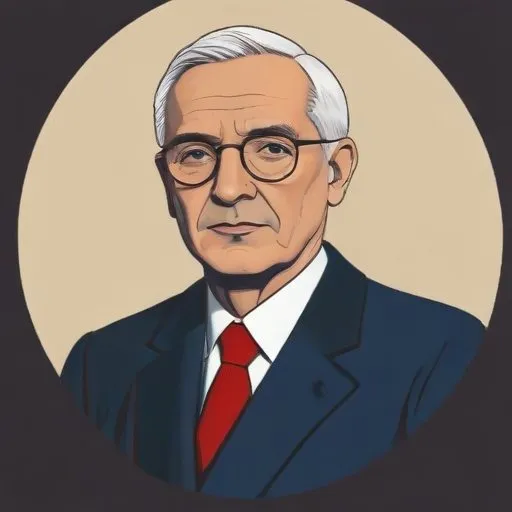
A 19th-century French polymath who made significant contributions to law, journalism, and history, particularly in the fields of constitutional law and the French Revolution.
Jean Denis is renowned for his groundbreaking work in number theory, specifically his discovery of the Denis' theorem, which has had a profound impact on the field of mathematics. His contributions have enabled mathematicians to better understand the properties of prime numbers and their applications in cryptography.
Jean Denis was born on February 27, 1902, in Paris, France. He developed a passion for mathematics from an early age and went on to pursue his higher education at the École Normale Supérieure (ENS). Denis' exceptional abilities earned him a scholarship to study at the prestigious institution, where he was mentored by the distinguished mathematician, Émile Picard.
Jean Denis' most notable achievement is his Denis' theorem, which he published in 1929. This theorem provides a fundamental basis for understanding the distribution of prime numbers and their relationships with other numbers. His work has far-reaching implications for cryptography, coding theory, and computer science.
Denis' other significant contributions include his work on Diophantine equations, elliptic curves, and the arithmetic of number fields. His research has been influential in shaping the course of number theory and has inspired generations of mathematicians.
Jean Denis was known for his humble and unassuming nature, often crediting his colleagues and predecessors for their contributions to his work. He believed that mathematics was a collaborative effort, and his own achievements were built upon the foundations laid by others.
Denis' philosophical approach to mathematics emphasized the importance of simplicity, elegance, and beauty in mathematical proofs and theories. He believed that the beauty of mathematics lay not only in its applicability but also in its inherent aesthetic value.
Jean Denis' work has had a significant impact on modern society, particularly in the realm of cryptography and data security. His theorem has been instrumental in the development of secure encryption algorithms, which are used to protect online transactions, communication networks, and sensitive data.
In addition, Denis' research has influenced the development of computer science, coding theory, and coding theory. His work has enabled the creation of more efficient algorithms, faster computers, and more reliable communication systems.
In 1935, Jean Denis was awarded the Prix Francoeur by the French Academy of Sciences for his outstanding contributions to number theory.
Denis served as a professor at the University of Paris from 1940 until his retirement in 1970. During his tenure, he supervised numerous Ph.D. students and inspired a new generation of mathematicians.
Jean Denis' legacy is that of a mathematician who dedicated his life to advancing the field of number theory. His work has had a profound and lasting impact on the development of cryptography, coding theory, and computer science.
Today, mathematicians and computer scientists continue to build upon Denis' theorem, exploring new applications and extensions of his work. His influence on modern society is a testament to the power of mathematics to shape our world.
Jean Denis' remarkable life and work serve as a testament to the power of mathematics to transform our understanding of the world and our place within it. His legacy continues to inspire mathematicians and scientists, ensuring that his work will have a lasting impact on modern society.
Born in 1769
A French military leader who rose to prominence during the French Revolution and became Emperor of France, known for his military conquests and reorganization of Europe. He is also famous for his Napoleonic Code, which remains a foundation of modern law.
Born in 1890
A French military leader who led the Free French Forces during WWII and later became President of France, known for his strong leadership and vision for a unified Europe.
Born in 1841
A French journalist, physician, and politician who served as Prime Minister of France during World War I, leading the country to victory and playing a key role in shaping the Treaty of Versailles. He's also known for his strong leadership and witty humor.
89 Years Old
French politician who served as Prime Minister from 1997 to 2002, known for his socialist policies and efforts to reduce unemployment.
Born in 1916
A French lawyer and politician who served as the 21st President of France, known for his socialist policies and role in shaping the European Union. He's also remembered for his controversial past and complex personality.
93 Years Old
A French military officer and statesman who served as President of France from 1995 to 2007, known for his opposition to the US-led invasion of Iraq and his efforts to strengthen the European Union.
71 Years Old
The 23rd President of France, a lawyer-turned-politician who led the country from 2007 to 2012, known for his efforts to reform the EU and his controversial domestic policies.
72 Years Old
The 24th President of France, a key European leader who implemented significant economic reforms and played a crucial role in shaping the European Union's policies, particularly during the European sovereign-debt crisis.
