


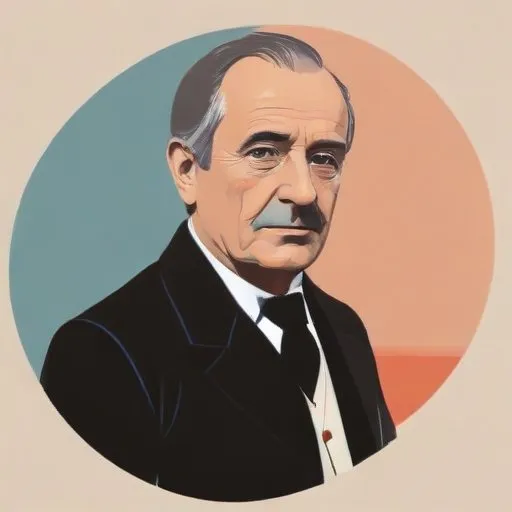
French historian, author, and diplomat who served as Ambassador to the United States, known for his writings on medieval history and his diplomatic efforts to strengthen Franco-American relations.
Jean Jules Jusserand, the renowned French author and diplomat, left an indelible mark on international relations during his tenure as the French Ambassador to the United States from 1903 to 1925. It was during this period that he played a pivotal role in shaping the course of World War I, leveraging his exceptional diplomatic acumen to forge crucial alliances and broker peace.
Born on February 18, 1855, into a wealthy Lyonnais family, Jusserand's childhood was a testament to his future diplomatic prowess. Split between his family's residence in Saint-Haon-le-Châtel and Chalons boarding school in Lyon, he developed a deep appreciation for diverse cultures and languages. This early exposure instilled in him a desire to excel in international relations, driven by a sense of duty to honor his late father.
Jusserand's academic pursuits took him to the University of Lyon, where he excelled in subjects as diverse as literature, science, law, and history. He received two licenses, in history and law, and went on to earn a doctorate in history, despite his family's initial reservations about his ability to complete his studies. This solid educational foundation laid the groundwork for his future success as a diplomat and author.
Jusserand's thirst for knowledge and cultural immersion led him to travel extensively, mastering multiple languages and discovering new horizons. This global odyssey prepared him for a career that would take him to the forefront of international diplomacy.
In 1878, Jusserand embarked on his diplomatic journey, applying to the Foreign Affairs national competition at the tender age of 23. He quickly rose through the ranks, starting as a student-consul and eventually becoming sous-chef of the cabinet de Barthélemy-Saint-Hilaire, where he worked under the Minister of Foreign Affairs.
His literary talents earned him a partnership with Paul Cambon, the Minister of France in Tunisia, in 1882. During this period, Jusserand played a crucial role in the administrative organization of the protectorate, earning him recognition as a respected diplomat and contributing to the humanization of the protectorate.
In 1903, Jusserand assumed the position of French Ambassador to the United States, a role he would fulfill for over two decades. During this critical period, he worked tirelessly to maintain Franco-American relations, playing a key role in shaping the Allied effort during World War I.
Jusserand's diplomatic career was marked by his exceptional ability to navigate complex international relationships, forging lasting bonds between nations. His legacy extends beyond his diplomatic achievements, serving as an inspiration to future generations of diplomats, scholars, and authors.
Through his remarkable life and career, Jean Jules Jusserand leaves behind a testament to the power of cultural immersion, academic rigor, and diplomatic finesse.
Born in 1858
A pioneering leader who championed progressive reforms, trust-busting, and conservation, earning a Nobel Peace Prize for mediating the Russo-Japanese War. He's also famous for his rugged outdoorsmanship and "big stick" diplomacy.
Born in 1845
A French diplomat who played a crucial role in negotiating the Treaty of Fez, which established French protectorate over Morocco, and was a key figure in shaping French foreign policy in the early 20th century.
Born in 1845
A prominent lawyer and politician who served as Secretary of State, earning a Nobel Peace Prize for his diplomatic efforts. He's most known for his work in international arbitration and conflict resolution.
Born in 1798
A 19th-century French historian and philosopher who pioneered a new approach to historical writing, focusing on the lives and experiences of ordinary people, rather than just monarchs and elites. He's also known for his vivid and poetic writing style.
