


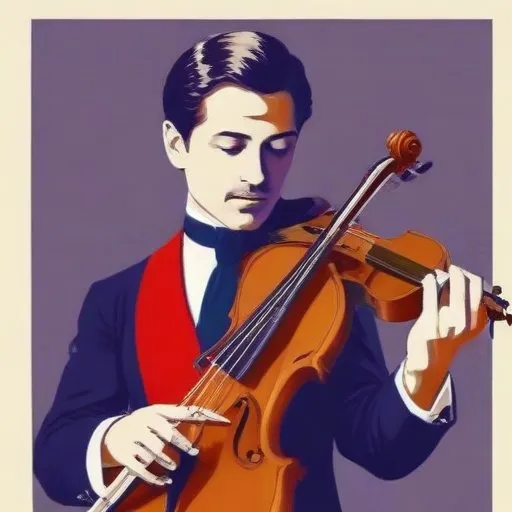
A virtuosic violinist and prolific composer, he crafted over 900 works, including sonatas, concertos, and operas, showcasing his mastery of Baroque music. His compositions remain a staple of classical music repertoire today.
JeanMarie Leclair, a renowned French Baroque violinist and composer, is widely regarded as the founder of the French violin school. His innovative and expressive compositions elevated the violin to new heights, earning him a prominent place in the history of classical music.
Born on May 10, 1697, in Lyon, France, Leclair began his musical journey at a young age. He initially studied dance and violin in Turin, where he honed his skills and developed a deep appreciation for the intricacies of music.
In 1723, Leclair returned to Paris, where he became a prominent figure in the city's musical scene. He performed at the Concert Spirituel, a prestigious music series, and gained recognition for his exceptional violin playing and compositional skills. His works, including sonatas for flute and basso continuo, showcased his mastery of melody and harmony.
In 1733, Leclair's talents caught the attention of Louis XV, who appointed him as the ordinaire de la musique (Director of Music) of the Chapel and the Apartments. This prestigious position cemented Leclair's status as a leading figure in French music. He dedicated his third book of violin sonatas to the king, solidifying his connection to the royal court.
Leclair's reputation extended beyond France, and he was soon engaged by the Princess of Orange, a talented harpsichordist and former student of Handel. From 1738 to 1743, he spent three months annually at her court in Leeuwarden, Netherlands, and the remainder of the year in The Hague, working as a private maestro di cappella. This period saw the creation of some of his most celebrated works, including his only opera, Scylla et Glaucus, which premiered in 1746.
After his stint with the Princess of Orange, Leclair returned to Paris and continued to compose and perform. He served the Duke of Gramont, contributing to various productions, including the opraballet Les amusemens lyriques in 1750. Leclair's impact on French music was profound, and he is remembered as a pioneer who elevated the violin to new heights.
Leclair's compositions are characterized by their lyricism, expressiveness, and technical complexity. His works, including sonatas, concertos, and operas, showcase his mastery of melody, harmony, and rhythm. He is credited with developing the French violin school, which emphasized elegance, precision, and refinement.
Leclair's influence extends beyond the Baroque period, and his music remains an integral part of classical music repertoire. His innovative compositions and virtuosic performances continue to inspire and challenge musicians today, making him a timeless figure in the world of music.
JeanMarie Leclair's remarkable life and accomplishments have left an indelible mark on the world of classical music. As a composer, violinist, and founder of the French violin school, he continues to inspire generations of musicians and music enthusiasts alike.
Born in 1700
A virtuosic flutist and composer, known for his expressive and technically demanding works that showcased the instrument's capabilities. He was a prominent figure in the French Baroque period, influencing the development of flute music.
Born in 1668
A renowned Baroque composer and organist, known for his intricate and expressive harpsichord music that showcased his mastery of counterpoint and ornamentation. His works continue to inspire and influence classical music today.
Born in 1683
A prominent figure in the Baroque period, this composer and theorist revolutionized Western classical music with innovative harmonies and treatises on music theory, shaping the course of classical music.
Born in 1705
A virtuosic musette player and composer, he crafted delightful Baroque music, particularly for the French court. His works showcased exceptional technique and lyricism.
Born in 1588
A 17th-century polymath who made significant contributions to mathematics, particularly in the discovery of prime numbers, and wrote extensively on philosophy and theology.
