


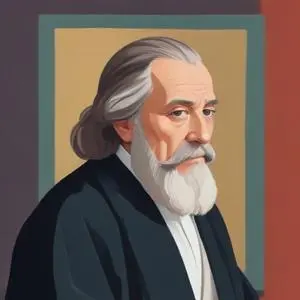
A 17th-century master of fables, crafting witty, moral tales that entertain and educate, still widely read and adapted today.
Jean de La Fontaine is renowned for his exquisite collection of fables, which have captivated readers for centuries with their wisdom, wit, and elegance. As one of the most celebrated French poets of the 17th century, La Fontaine's work has inspired generations of writers, philosophers, and artists, securing his place as a literary icon.
Born on July 8, 1621, in Château-Thierry, France, La Fontaine was the eldest child of Charles de La Fontaine, a "maître des eaux et forts" (a kind of deputy ranger), and Françoise Pidoux. His family, from the highest provincial middle class, was not noble, but his father was fairly wealthy. La Fontaine received his education at the collège grammar school of Château-Thierry and later entered the Oratory in May 1641, and the seminary of Saint-Magloire in October of the same year. However, he soon realized that he had mistaken his vocation and left the seminary.
In 1647, La Fontaine's father resigned his rangership in his favor, and arranged a marriage for him with Marie Hricart, a 14-year-old girl who brought him 20,000 livres and expectations. Although the couple did not get along well, there is no ground for the scandalous rumors raised by gossip or personal enemies of La Fontaine. La Fontaine studied law and was admitted as an advocat (lawyer), but his true passion lay in writing.
La Fontaine's masterpiece, Fables, was first published in 1668 and consists of 12 books of poems, each containing 10-20 fables. These tales, drawn from ancient Greek and Roman sources, were reimagined with La Fontaine's unique wit, humor, and insight into human nature. The Fables were an instant success, providing a model for subsequent fabulists across Europe and numerous alternative versions in France, as well as in French regional languages.
After a long period of royal suspicion, La Fontaine was finally admitted to the French Academy in 1684, solidifying his reputation in France. Today, evidence of his enduring legacy can be found in the many pictures, statues, medals, coins, and postage stamps featuring his image. La Fontaine's work has had a profound impact on French literature, and his Fables remain a timeless treasure, continuing to inspire and delight readers of all ages.
La Fontaine's work has had a lasting impact on literature, art, and popular culture. His Fables have been translated into numerous languages, adapted into various forms of media, and continue to inspire new generations of writers, artists, and thinkers.
La Fontaine's recognition and accolades include:
La Fontaine's life and work are a testament to the cultural and intellectual richness of 17th-century France. His Fables have become an integral part of French literary heritage, continues to inspire and delight readers, and remain a timeless treasure of world literature.
Born in 1639
A 17th-century master of French tragedy, crafting intricate, psychologically complex dramas that probed the human condition, influencing the development of Western theatre.
Born in 1622
A 17th-century master of comedy, he penned witty plays that satirized the French aristocracy, leaving a lasting impact on Western theater. His works remain widely performed and adapted today.
Born in 1606
A 17th-century French mastermind behind iconic plays like "Le Cid" and "Horace", known for pioneering the classical French tragedy genre.
Born in 1694
A witty and insightful 18th-century writer and philosopher who used satire to critique societal norms and advocate for reason, tolerance, and human rights.
Born in 1712
A pioneering thinker who shaped modern democracy and education with his ideas on social contracts, general will, and the importance of early childhood education. His writings influenced the French Revolution and modern political thought.
Born in 1651
A 17th-century French archbishop and poet who wrote influential works on spirituality and morality, including the famous novel "Telemachus".
Born in 1636
A 17th-century French poet and critic who advocated for reason and morality in literature, and is known for his influential writings on poetry and aesthetics.
