


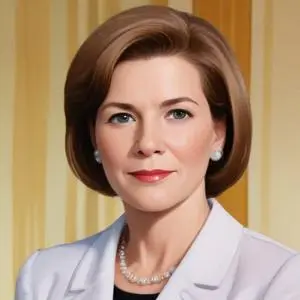
The first female US Ambassador to the UN, serving from 1981 to 1985, known for her neoconservative views and strong anti-communist stance during the Cold War era. She played a significant role in shaping US foreign policy under President Ronald Reagan.
Jeane Kirkpatrick, the first woman to serve as United States Ambassador to the United Nations, is known for her unwavering commitment to realpolitik and her influential role in shaping the foreign policy of the Ronald Reagan administration. Her doctrine, which advocated for supporting authoritarian regimes that aligned with Washington's interests, continues to spark controversy and debate among scholars and policymakers alike.
Born on November 19, 1926, in Duncan, Oklahoma, Jeane Duane Kirkpatrick nee Jordan grew up in a family of modest means. Her father, an oilfield wildcatter, moved the family to Mt. Vernon, Illinois, when Jeane was 12. She graduated from Mt. Vernon Township High School and went on to attend Stephens College in Columbia, Missouri, where she earned her associate degree. In 1948, she graduated from Barnard College of Columbia University.
Kirkpatrick's diplomatic career spanned over three decades, during which she served as a foreign policy adviser to Ronald Reagan's presidential campaign in 1980. Her expertise and dedication earned her the appointment as the first woman to serve as United States Ambassador to the United Nations, a position she held from 1981 to 1985. During her tenure, she played a pivotal role in shaping the Reagan administration's foreign policy, particularly in regards to Central America and the Soviet Union.
The Kirkpatrick Doctrine, which posits that traditional authoritarian governments are less repressive than revolutionary autocracies, remains a contentious topic in the realm of international relations. According to Kirkpatrick, authoritarian regimes could be led towards democracy through example, and it was imperative for the United States to support those that aligned with Washington's interests.
Kirkpatrick's unwavering support for authoritarian regimes, such as the Argentine junta during the Falklands War, drew criticism from human rights advocates and Democrats alike. Her controversial stance on Chile's Augusto Pinochet and her perceived softness on human rights issues continue to be debated among scholars and policymakers.
After leaving government service in 1985, Kirkpatrick went on to write a syndicated newspaper column, specializing in analysis of the activities of the United Nations. She passed away on December 7, 2006, leaving behind a legacy that continues to influence American foreign policy.
Kirkpatrick's philosophical contributions to the field of international relations are undeniable. Her realist approach to foreign policy, which emphasized the importance of national security and strategic interests, continues to shape the way policymakers approach global politics. Her belief in the ability of authoritarian regimes to transition towards democracy through example remains a topic of debate among scholars.
"The central reality of international politics is the existence of states that are capable of defending themselves, and those that are not."
Kirkpatrick's legacy continues to influence American foreign policy, with her doctrine remaining a topic of debate among scholars and policymakers alike. Her unwavering commitment to realpolitik and her advocacy for supporting authoritarian regimes that align with Washington's interests have left an indelible mark on the field of international relations.
Born in 1911
The charismatic leader who championed conservative policies, helped end the Cold War, and is often credited with restoring American pride and optimism. He's also remembered for his folksy, actor-honed communication style.
Born in 1924
The 41st President of the United States, a decorated war hero and skilled diplomat, led the country through the end of the Cold War and Gulf War. He's known for his foreign policy expertise and "kinder, gentler nation" vision.
89 Years Old
The first female US Secretary of State, serving from 1997 to 2001, who played a key role in shaping American foreign policy during the Clinton administration. She's known for her strong diplomatic efforts and advocacy for democracy and human rights.
Born in 1923
A renowned diplomat and strategist who played a pivotal role in shaping global politics during the Cold War era, known for his Realpolitik approach and brokering peace agreements .
98 Years Old
A Polish-born American strategist and policymaker who served as National Security Advisor, shaping US foreign policy and advising presidents on global affairs. Known for his realist approach and expertise on geopolitics.
55 Years Old
An Irish-American journalist, academic, and diplomat who served as the 28th United States Ambassador to the United Nations, known for her humanitarian work and advocacy for human rights.
61 Years Old
The 24th United States National Security Advisor, serving under President Barack Obama, is a highly influential figure in American foreign policy and international relations, known for shaping global security strategies.
71 Years Old
The first African American woman to serve as Secretary of State, she played a crucial role in shaping US foreign policy during a tumultuous period, earning her a lasting legacy in international relations.
