


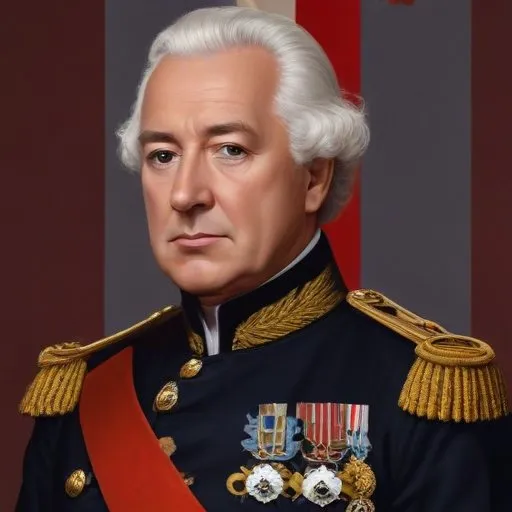
A British field marshal and politician who served as the 19th Governor General of Canada, known for his military victories and role in shaping Canada's early history.
Jeffery Amherst, 1st Baron Amherst, is credited as the mastermind behind Britain's successful campaign to conquer the territory of New France during the Seven Years War. Under his command, British forces captured key cities like Louisbourg, Quebec City, and Montreal, cementing his legacy as a brilliant military strategist.
Born on 29 January 1717, in Sevenoaks, England, Amherst was the son of Jeffrey Amherst, a Kentish lawyer, and Elizabeth Amherst (née Kerrill). At a young age, he became a page to the Duke of Dorset, which marked the beginning of his illustrious military career.
Amherst's military career spanned over four decades, during which he participated in several notable battles, including the War of the Austrian Succession, where he served as an aide to General John Ligonier. He was promoted to lieutenant colonel in 1745 and saw action at the Battle of Rocoux in 1746.
In 1756, Amherst was appointed as the Commander-in-Chief of the British forces in North America, tasked with capturing the French stronghold of Louisbourg. He successfully besieged the city, which fell on 8 June 1758. This victory paved the way for the British to push further into New France, capturing Quebec City in 1759 and Montreal in 1760.
Amherst's military prowess and strategic thinking played a crucial role in Britain's victory in the Seven Years War, earning him the title of 1st Baron Amherst in 1766.
Amherst's legacy is marred by controversy, particularly his role in the Pontiac's War, where he expressed a desire to spread smallpox among disaffected Native American tribes. This episode has led to a reevaluation of his legacy, with many cities and institutions reconsidering their association with him.
In 2019, the city of Montreal removed his name from a street, renaming it Rue Atateken, in recognition of the Kanien'kehá:ka Mohawk language.
Despite the controversy surrounding his legacy, Amherst's contributions to British history cannot be ignored. He played a significant role in shaping the course of North American history, and his military campaigns paved the way for British expansion in the region.
Today, numerous places and streets in Canada and the United States bear his name, a testament to his enduring impact on the region.
Despite the complexities of his legacy, Jeffery Amherst, 1st Baron Amherst, remains an important figure in British history, whose military campaigns and strategic thinking continue to fascinate historians and military enthusiasts alike.
Born in 1727
Led British forces to victory in the Battle of Quebec in 1759, a pivotal moment in the French and Indian War, and is considered a hero in British military history.
Born in 1725
A British military leader who conquered Bengal, India, and later became a politician, known for his significant role in establishing British rule in India.
41 Years Old
A Welsh rugby union player who captained Wales and the British and Irish Lions, known for his exceptional skill and leadership on the pitch.
97 Years Old
An American-Irish poet and academic, known for his lyrical and introspective poetry that explores themes of identity, history, and the human condition. His work is characterized by its accessibility and musicality.
