


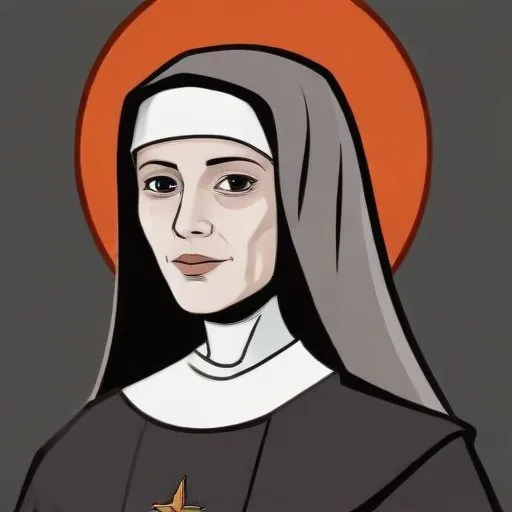
A Spanish Catholic nun who founded the first monastery in Manila, establishing a stronghold for Catholicism in the Philippines and paving the way for future female religious leaders.
Jernima de la Asuncin, a Spanish Catholic nun, is renowned for founding the Real Monasterio de Santa Clara (Royal Monastery of Saint Clare) in Intramuros, Manila, Philippines, marking the first Catholic monastery in the Far East. Her pioneering effort earned her an apostolic decree for beatification in 1734, cementing her legacy as a champion of Catholicism in the region.
Born on May 9, 1555, in Toledo, Spain, Jernima grew up in a pious and prosperous family, instilling in her a strong foundation in Christian life. Her childhood was spent on the Calle de los Letrados, next to the Church of San Marcos, where she developed a deep sense of spirituality.
At the tender age of 14, Jernima met the influential Carmelite reformer, Teresa of Ávila, an encounter that sparked her desire to pursue a monastic life. The biography of Clare of Assisi further fueled her ambition, leading her to join the enclosed monastery of Santa Isabel la Real de Toledo on August 15, 1570.
Within the monastery, Jernima demonstrated exceptional dedication and versatility, assuming various roles such as nurse, henkeeper, sacristan, vicar of the choir, and provisioner. Her reputation as a holy woman spread, attracting wealthy donors who sought her prayers and gifts. She commissioned devotional artwork and statues, showcasing her artistic flair.
Jernima's compassion extended beyond the convent walls. She distributed food and aid to the needy, including prisoners and hospital patients. Her generosity earned her recognition as a beacon of hope and kindness.
In 1599, Dominican Diego Soria approached Jernima with a vision to establish a convent in Manila. This proposition ignited a fire within her, and she embarked on a perilous journey to the Philippines, driven by her unwavering commitment to spreading Catholicism.
Jernima's tireless efforts ultimately gave birth to the Real Monasterio de Santa Clara, which became a symbol of hope and spiritual growth in the region. Her pioneering spirit inspired countless individuals, solidifying her place in history as a trailblazer for Catholicism in the Far East.
Jernima de la Asuncin's remarkable journey has left an indelible mark on the world. Her courage, compassion, and unwavering dedication to her faith have inspired generations. The Real Monasterio de Santa Clara, immortalized in José Rizal's novel Noli Me Tángere, stands as a testament to her unrelenting spirit and sacrifice.
As a champion of Catholicism, Jernima de la Asuncin's beatification in 1734 cemented her status as a revered figure in the Catholic Church. Her legacy continues to inspire and motivate, serving as a beacon of hope for those seeking spiritual guidance and enlightenment.
Jernima de la Asuncin's remarkable life serves as a testament to the power of faith, compassion, and determination. Her legacy will continue to inspire generations, ensuring that her message of hope and spiritual growth endures.
Born in 1491
Founded the Jesuit Order, a Catholic religious organization known for its missionary and educational work, and developed the Spiritual Exercises, a guide for spiritual growth and discernment.
Born in 1506
Co-founder of the Society of Jesus, a Catholic religious order, known for his missionary work in Asia, especially in India and Japan, and for his role in the Counter-Reformation. He's revered for his tireless efforts to spread Christianity and his compassion for the poor and marginalized.
Born in 1500
Ruling over a vast empire from 1519 to 1556, he was a powerful and influential leader who played a crucial role in shaping European politics and religion. He is most known for his efforts to unify Christian Europe and defend it against the Ottoman Empire.
Born in 1417
A 15th-century pope who played a significant role in the fall of the Western Schism, ending the division in the Catholic Church. He's also known for his lavish spending and nepotism.
