


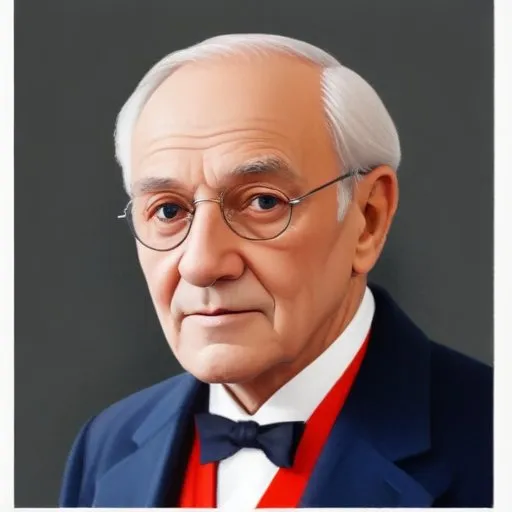
Developed a method to determine the structure of molecules, earning a Nobel Prize in Chemistry in 1985 for his work on X-ray crystallography. His research has greatly advanced our understanding of molecular structures and their properties.
Jerome Karle, an American physical chemist, is renowned for his groundbreaking work in crystallography, earning him the Nobel Prize in Chemistry in 1985. Alongside Herbert A. Hauptman, Karle developed a method for direct analysis of crystal structures using X-ray scattering techniques, revolutionizing the field of chemistry.
Born Jerome Karfunkle on June 18, 1918, in New York City, Karle grew up in a Jewish family with a strong affinity for the arts. Despite his early interest in piano and participation in competitions, Karle's passion for science prevailed. He attended Abraham Lincoln High School in Brooklyn, where he would later join the ranks of Nobel laureates Arthur Kornberg and Paul Berg as esteemed alumni.
Karle's academic prowess was evident from an early age, as he enrolled in college at 15 and graduated from the City College of New York in 1937 with a bachelor's degree. He then pursued a master's degree in biology from Harvard University in 1938. To support his further graduate studies, Karle worked at the New York State Department of Health in Albany, where he developed a method to measure dissolved fluoride levels, a technique that became a standard for water fluoridation.
Karle enrolled at the University of Michigan in 1940, where he met his future wife, Isabella Lugoski, and completed his PhD studies in 1943 under the supervision of physical chemist Lawrence Brockway. His work in crystallography led to numerous publications and awards, solidifying his position as a leading expert in the field.
In 1985, Karle's pioneering work in crystallography earned him the Nobel Prize in Chemistry, along with Herbert A. Hauptman. This recognition further cemented his legacy in the scientific community. Karle also served as president of the American Crystallographic Association, further demonstrating his dedication to the field.
Karle's groundbreaking work in crystallography has had far-reaching implications for various fields, including chemistry, biology, and materials science. His method for direct analysis of crystal structures has enabled researchers to better understand the properties of materials, leading to advancements in fields such as pharmaceuticals, nanotechnology, and energy storage.
Karle's personal life was marked by a strong sense of family and community. He married Isabella Lugoski in 1942, and they had three children together. Karle's commitment to his work and family was unwavering, and he continued to contribute to the scientific community until his passing on June 6, 2013.
Jerome Karle's pioneering work in crystallography has left an indelible mark on the scientific community. His contributions have enabled researchers to better understand the properties of materials, driving advancements in various fields. As a Nobel laureate, Karle's legacy serves as an inspiration to future generations of scientists, solidifying his position as a true giant in the world of chemistry.
Born in 1901
Pioneering chemist and peace activist who won two unshared Nobel Prizes, one for chemistry and one for peace, for his groundbreaking work on the nature of the chemical bond and his tireless efforts to promote nuclear disarmament.
Born in 1902
Pioneering geneticist who discovered transposons, mobile genetic elements that jump from one location to another in a genome, revolutionizing our understanding of genetic variation and evolution.
98 Years Old
Discovered the structure of DNA, revolutionizing our understanding of genetics and earning a Nobel Prize. Pioneering work in molecular biology has far-reaching implications for medicine and beyond.
Born in 1916
Pioneering scientist who discovered the structure of DNA, revolutionizing our understanding of genetics and life itself.
Born in 1916
A Nobel Prize-winning physicist and biologist who contributed significantly to the discovery of the structure of DNA, using X-ray crystallography to produce the first clear images of the molecule.
Born in 1920
A British scientist who contributed significantly to the discovery of the structure of DNA, providing high-quality X-ray crystallography images that helped James Watson and Francis Crick develop their famous model.
Born in 1918
A brilliant physicist and engineer who pioneered quantum mechanics and famously explained complex concepts in simple terms, making science accessible to all.
