


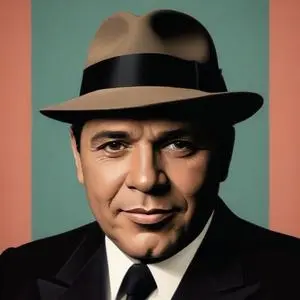
Leader of the International Brotherhood of Teamsters labor union, notorious for his mysterious disappearance and alleged ties to organized crime.
Jimmy Hoffa, the infamous labor union leader, is best known for his presidency of the International Brotherhood of Teamsters (IBT) from 1957 to 1971, during which time he secured the first national agreement for teamsters rates and grew the union to become the largest in the United States with over 2.3 million members.
Hoffa was born on February 14, 1913, in Brazil, Indiana, to John and Viola Hoffa. His father, of German descent, died in 1920, and the family moved to Detroit in 1924. Hoffa's early life was marked by poverty and hardship, which would later shape his perspective on labor unions and workers' rights.
Hoffa's involvement with the IBT began in the 1930s, and by his mid-20s, he had become an important regional figure. He was elected national vice-president of the IBT in 1952 and went on to become the general president of the union in 1957.
Hoffa's presidency of the IBT was marked by significant accomplishments, including securing the National Master Freight Agreement in 1964, which established standardized rates for teamsters across the country. However, his time as leader was also marred by controversy, including his conviction of jury tampering, attempted bribery, conspiracy, and mail and wire fraud in 1964.
Despite his conviction, Hoffa maintained a strong grip on the union and continued to wield significant influence. However, his involvement with organized crime, which began in the early years of his Teamsters work, ultimately contributed to his downfall.
Hoffa's disappearance on July 30, 1975, remains one of the most infamous unsolved mysteries in American history. He is widely believed to have been murdered by the Mafia, and was declared legally dead in 1982.
Despite the controversy surrounding his life and disappearance, Hoffa's legacy as a labor leader continues to be debated. While some view him as a champion of workers' rights, others see him as a corrupt figure who exploited his position for personal gain.
Hoffa's belief in the power of labor unions to improve workers' lives was a driving force behind his actions as leader of the IBT. He was a fierce advocate for workers' rights and believed that collective bargaining was essential to achieving fair wages and working conditions.
Hoffa's legacy extends beyond the labor movement to broader American society. His rise to power and subsequent fall from grace serve as a cautionary tale about the dangers of corruption and the importance of accountability.
Despite the controversy surrounding his life, Hoffa's influence on the labor movement and American society as a whole is undeniable. His story serves as a reminder of the importance of ethical leadership and the need for transparency and accountability in all aspects of life.
Born in 1913
The 37th President of the United States, a polarizing figure who led the country through significant domestic and foreign policy changes, infamous for his involvement in the Watergate scandal.
Born in 1917
The 35th President of the United States was a charismatic leader who navigated the country through the Cuban Missile Crisis and advocated for civil rights, leaving a lasting legacy in American politics.
Born in 1925
A Navy officer, lawyer, and politician who served as US Attorney General, playing a key role in the Civil Rights Movement and advocating for social justice. He was a prominent figure in American politics during the 1960s.
Born in 1915
A legendary entertainer who charmed audiences with smooth vocals and iconic film roles, leaving an indelible mark on American popular culture.
Born in 1910
Notorious crime boss who ruled New Orleans' underworld, infamous for alleged involvement in JFK's assassination.
Born in 1893
The 5th Director of Central Intelligence was a master spy and diplomat who oversaw the CIA during the Cold War, orchestrating covert operations and shaping global politics. He's infamous for his role in the Bay of Pigs invasion and CIA-led coups.
Born in 1895
The first Director of the FBI, who led the agency for nearly five decades, building it into a powerful force in American law enforcement, and notorious for his secretive and authoritarian style. He's infamous for his surveillance and harassment of political dissidents, civil rights leaders, and celebrities.
