


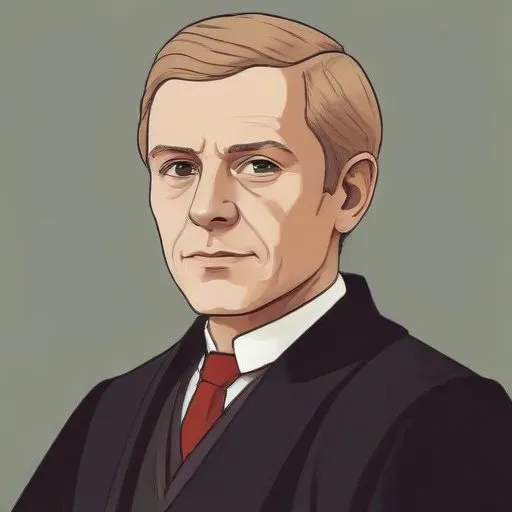
A Dutch historian, jurist, and politician who played a crucial role in shaping the Netherlands' constitution and government, earning him recognition as a key figure in the country's modernization.
Johan Rudolph Thorbecke is revered as one of the most influential Dutch politicians of the 19th century, celebrated for his pivotal role in drafting the revised Constitution of the Netherlands in 1848. This monumental achievement transformed the country from an absolute monarchy to a constitutional monarchy, granting unprecedented power to the States General and the Council of Ministers, while limiting the king's authority.
Born on January 14, 1798, in Zwolle, Netherlands, Thorbecke was the son of Frederik Willem, a Lutheran tobacco manufacturer of German descent, and Christine Regina, born in Osnabrück, Lower Saxony. Despite his family's financial struggles, Thorbecke's parents made immense sacrifices to provide him with a decent education. He demonstrated exceptional intelligence and diligence from a young age, attending primary school in Zwolle and Amsterdam, and later studying classical literature and philosophy in Amsterdam and Leiden.
Thorbecke's academic excellence earned him a state scholarship to travel through Germany, where he lectured at the University of Giessen. His academic achievements and philosophical contributions soon propelled him into the realm of politics. In 1844, he became a member of the Provincial States of Holland, marking the beginning of his illustrious political career.
Thorbecke's crowning achievement was his leadership of the commission that drafted the revised Constitution of the Netherlands in 1848. This document not only established a constitutional monarchy but also granted individual rights to citizens and residents, making it one of the most progressive constitutions of its time. This reform has had a lasting impact on the Netherlands' political system, earning Thorbecke the title of "founding father" of the country's modern politics.
Thorbecke's philosophical views were shaped by his study of classical literature and philosophy. He believed in the importance of individual rights, liberty, and the separation of powers. His commitment to these principles is reflected in the Constitution, which enshrines the rule of law, freedom of expression, and the protection of human rights.
Thorbecke's legacy extends beyond the Netherlands' borders. His advocacy for individual rights, constitutional monarchy, and the separation of powers has inspired similar reforms in other countries. His influence on modern society is a testament to the enduring power of his ideals.
"The state is not an end in itself, but a means to an end. The end is the free development of the individual." - Johan Rudolph Thorbecke
Thorbecke's contributions coincided with the liberal democratic revolutions of 1848, which swept across Europe. His legacy is a reflection of the Netherlands' commitment to democracy, human rights, and the rule of law. Today, Thorbecke is celebrated as a champion of liberty and a pioneer of modern politics.
In conclusion, Johan Rudolph Thorbecke's remarkable life and achievements have left an indelible mark on the Netherlands and beyond. His unwavering commitment to individual rights, liberty, and democracy has inspired generations of politicians, scholars, and citizens alike.
Born in 1772
King of the Netherlands who played a key role in the country's independence and modernization, and is also known as the "Founder of the Fatherland".
Born in 1772
King of the Netherlands who played a key role in the country's independence and modernization, and is also known as the "Founder of the Fatherland".
Born in 1792
King of the Netherlands from 1840 to 1849, known for his conservative and authoritarian reign, which led to the adoption of a more liberal constitution. He was also a skilled military leader.
Born in 1851
Pioneering astronomer who discovered the star streaming motion and developed a model of the Milky Way galaxy, making significant contributions to our understanding of the universe.
Born in 1869
A Dutch politician who served as Prime Minister of the Netherlands from 1925 to 1926 and again from 1933 to 1939, known for his economic policies and leadership during the Great Depression.
