


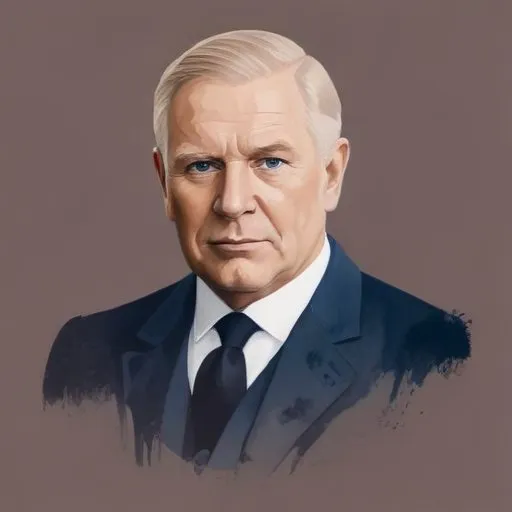
Led Finland through World War II, maintaining its independence despite Soviet pressure, and implemented significant economic reforms. Oversaw Finland's transition from an agrarian to an industrial society.
Johan Wilhelm Rangell, born on October 25, 1894, is best known for his tenure as the Prime Minister of Finland from 1941 to 1943, navigating the country through the tumultuous years of World War II. During his premiership, Rangell's expertise in economic issues played a crucial role in Finland's war efforts, earning him a place in the country's history books.
Rangell's academic pursuits led him to study law, which would eventually become the foundation of his career as a banker in the Bank of Finland. His connections with President Risto Ryti, whom he would later serve alongside, date back to this period.
When President Kysti Kallio resigned during the Interim Peace, Risto Ryti was elected as the new president, and Rangell rose to the position of Prime Minister. His experience in economic matters made him an invaluable asset to the Finnish government, particularly in the face of war.
Rangell's cabinets supported the Continuation War, which aimed to regain the territories lost in the Peace of Moscow. However, his political orientation, which some perceived as pro-German, sparked controversy. During a state visit by Reichsführer-SS Heinrich Himmler in 1942, Rangell famously silenced Himmler's inquiries about the Jewish minority in Finland by stating, "Wir haben keine Judenfrage" (We do not have a Jewish question).
After serving as the governor of the Bank of Finland from 1943 to 1944, Rangell was convicted of alleged crimes against peace in 1946 and sentenced to six years in prison. He was later pardoned in 1949. Rangell dedicated the remainder of his life to serving the Finnish Olympic Committee and the International Olympic Committee until 1967. He also held a position on the board of Kansallis-Osake-Pankki bank.
Johan Wilhelm Rangell's life and career serve as a testament to his unwavering commitment to public service and his country. Though controversy surrounded his premiership, his contributions to Finland's economy and war efforts remain undeniable. Today, Rangell is remembered as a significant figure in Finnish history, his legacy a blend of accomplishments and challenges.
Born in 1889
A Finnish lawyer and politician who served as the Governor of the Bank of Finland and the 5th President of Finland, known for leading the country through World War II. He played a crucial role in maintaining Finland's independence and sovereignty during the war.
Born in 1870
A Finnish statesman who played a crucial role in shaping Finland's post-WWII foreign policy and maintaining the country's independence during the Cold War era. He's known for his pragmatic and diplomatic approach to politics.
Born in 1873
A Finnish farmer, banker, and politician who served as the 4th President of Finland, known for his role in shaping the country's post-WWII economy and politics. He's remembered for his humble, down-to-earth leadership style.
Born in 1881
The Prime Minister of Finland who led the country through post-WWII reconstruction and implemented significant social and economic reforms. He's most known for his efforts to establish Finland as a neutral state during the Cold War.
Born in 1900
A Finnish leader who served as President from 1956 to 1982, known for maintaining Finland's neutrality during the Cold War and fostering good relations with the Soviet Union.
