


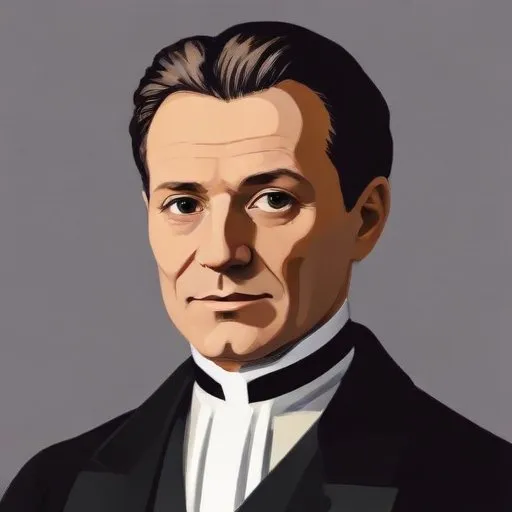
A pioneering German physician, physiologist, and anatomist who coined the term "psychiatry" and made significant contributions to the field of mental health, particularly in understanding the brain's role in behavior.
Johann Christian Reil, a German physician, physiologist, anatomist, and psychiatrist, is renowned for coining the term "psychiatry" (Psychiatrie in German) in 1808, revolutionizing the field of mental health. This pioneering figure is credited with establishing psychiatry as a distinct discipline, separate from theology, penal practice, and medicine, and paved the way for modern psychiatry.
Reil was born on February 20, 1759, in northwest Germany, as the son of a Lutheran pastor. He was one of five children and grew up in a family that valued education. Reil pursued medicine, studying at the University of Göttingen, where he became acquainted with the scientist Johann Friedrich Blumenbach, a prominent figure in the field of physiology.
Reil's contributions to the field of psychiatry are multifaceted. He established the first journal of physiology written in German, the Archiv für die Physiologie, in 1795. This journal served as a platform for German-speaking scientists to share their research and ideas, promoting the development of physiology and psychiatry. In 1802, Reil became the director of a hospital in Halle, Germany, where he developed a medical program based on Friedrich Schelling's Naturphilosophie. This program emphasized the importance of understanding the human body as a holistic system, rather than just focusing on individual parts.
In 1808, Reil published a short-lived journal with J.C. Hoffbauer, titled Beyträge zur Beförderung einer Kurmethode auf psychischem Wege. It was in this journal that Reil introduced the term "Psychiaterie" (psychiatry), arguing that mental health treatment required a distinct discipline with trained practitioners. This marked a significant shift in the approach to mental health, as Reil advocated for a more compassionate and humane treatment of the insane.
Reil's philosophical contributions were deeply rooted in Schelling's Naturphilosophie, which emphasized the interconnectedness of human beings and the natural world. He believed that mental health treatment should focus on the individual's psyche, rather than just the physical body. This approach led to the development of the "moral treatment" movement, which emphasized kindness, empathy, and compassion in the treatment of the mentally ill.
Reil's contributions to psychiatry have had a lasting impact on modern society. He is credited with raising awareness about the plight of the insane and advocating for more humane treatment methods. His work paved the way for future generations of psychiatrists, including Sigmund Freud, who built upon Reil's ideas and further developed the field of psychotherapy.
Johann Christian Reil's work has left an indelible mark on the field of psychiatry. His contributions have inspired generations of psychiatrists, philosophers, and scientists, shaping our understanding of mental health and treatment. Today, Reil is remembered as a visionary who dared to challenge the status quo, advocating for a more compassionate and humane approach to mental health care.
Born in 1755
A pioneering physician, anthropologist, and paleontologist who made significant contributions to the fields of anatomy, anthropology, and paleontology, particularly in the discovery of early human fossils.
Born in 1758
Developed the field of phrenology, which linked brain regions to personality traits and intelligence, and mapped the brain's surface to identify specific "organs" responsible for various cognitive functions.
Born in 1659
Developed the phlogiston theory, a precursor to modern chemistry, and made significant contributions to the field of medicine.
Born in 1514
A pioneering figure in the study of human anatomy, known for performing detailed dissections and creating accurate drawings of the body's inner workings, revolutionizing medical understanding.
Born in 1668
A Dutch botanist and physician who laid the foundations for modern medicine by emphasizing clinical observation, experimentation, and scientific rigor, and is considered the father of physiology.
