


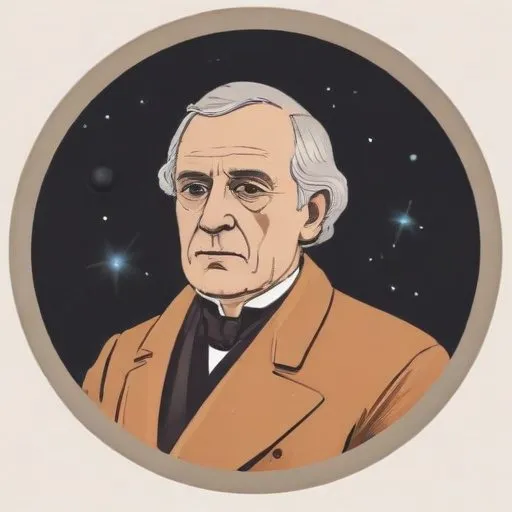
Astronomer who discovered the comet Encke, a periodic comet that takes only 3.3 years to orbit the sun, and made significant contributions to astronomy, particularly in the field of celestial mechanics.
Johann Franz Encke, a renowned German astronomer, is best known for his groundbreaking work on calculating the periods of comets and asteroids, as well as measuring the distance from the Earth to the Sun. His meticulous observations of the planet Saturn also contributed significantly to the field of astronomy.
Encke was born on September 23, 1791, in Hamburg, Germany, to a family of modest means. His father, a pastor at St. James Church, Hamburg, passed away when Encke was just four years old. Thanks to the financial assistance of a teacher, Encke was able to pursue his education at the Gelehrtenschule des Johanneums.
Encke's journey in astronomy began in 1811 when he studied mathematics and astronomy under the tutelage of Carl Friedrich Gauss at the University of Göttingen. During his time at the university, Encke enlisted in the Hanseatic Legion for the campaign of 1813-1814, serving as a sergeant in the artillery of the Prussian army. After the war, he resumed his studies and eventually became an assistant to Bernhardt von Lindenau at the observatory of Seeberg near Gotha.
Encke's most notable contributions include:
Encke's work on comets and asteroids was instrumental in expanding our understanding of these celestial bodies. His calculations and measurements paved the way for future astronomers to build upon his research.
Encke's life was marked by significant personal milestones, including:
Encke's contributions to astronomy have had a lasting impact on modern society. His work on comets and asteroids has enabled scientists to better understand these celestial bodies and their potential impact on our planet. Furthermore, his measurements of the distance from the Earth to the Sun have helped us better comprehend the scale of our solar system.
Johann Franz Encke's legacy in astronomy is undeniable. His meticulous work and groundbreaking discoveries have inspired generations of astronomers. Today, his name is synonymous with excellence in astronomy, and his contributions continue to shape our understanding of the universe.
Born in 1777
A pioneer in mathematics and physics, he made major contributions to number theory, algebra, and electromagnetism, shaping our understanding of the natural world.
Born in 1784
Developed the Bessel functions, a set of mathematical equations crucial for astronomy, navigation, and engineering, and made the first accurate measurement of a star's distance from Earth.
Born in 1749
Developed nebular hypothesis of the origin of the solar system and formulated Laplace's equation, a fundamental concept in mathematics and physics. He's considered the founder of celestial mechanics.
Born in 1759
A renowned poet and playwright who crafted influential works that explored the human condition, morality, and the struggle for freedom, leaving a lasting impact on German literature.
Born in 1769
A pioneering geographer and explorer who mapped much of South America and discovered the Caspian Sea's connection to the Black Sea, greatly advancing our understanding of the natural world.
