


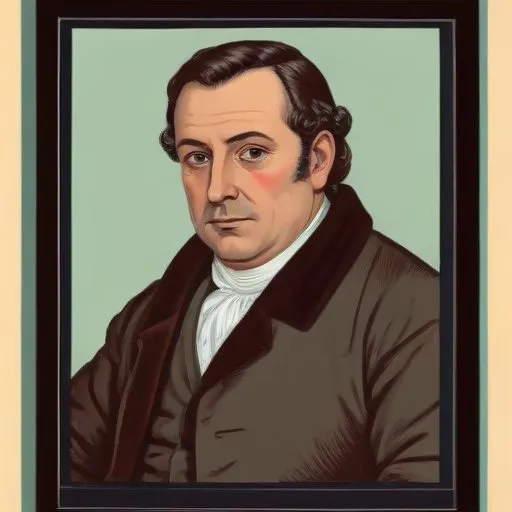
A Livonian physician and botanist who discovered and described several species of plants and insects, and is considered one of the founders of entomology. He also made significant contributions to the field of parasitology.
Johann Friedrich von Eschscholtz, a Baltic German physician, naturalist, and entomologist, is renowned for being one of the earliest scientific explorers of the Pacific region. His groundbreaking collections of flora and fauna in Alaska, California, and Hawaii remain a testament to his insatiable curiosity and passion for discovery.
Born on November 1, 1793, in Dorpat, Livonia (present-day Estonia), Eschscholtz was the son of ethnic Baltic Germans, Johann Gottfried and Katherine Hedwig Ziegler Eschscholtz. He pursued his higher education at the University of Dorpat, where he studied medicine and zoology. During this period, he served as an assistant to Carl Friedrich von Ledebour, a professor of botany, and received his medical degree in 1815.
On the recommendation of Ledebour, Eschscholtz embarked on a remarkable journey as the surgeon and naturalist on the Russian expeditionary ship Rurik, commanded by Otto von Kotzebue. From 1815 to 1818, the expedition circumnavigated the globe, seeking a Northwest Passage and exploring the lands bordering the Pacific Ocean. Eschscholtz was accompanied by a talented team of scientists, including botanist Adelbert von Chamisso and artist Louis Choris.
Their epic journey took them to the Canary Islands, Brazil, Cape Horn, Kamchatka, the Aleutian Islands, California, and Hawaii. At each stop, Eschscholtz meticulously collected specimens and recorded his observations of the local flora and fauna. His collaborative spirit and friendship with Chamisso resulted in a treasure trove of scientific discoveries.
Kotzebue's publication of the expedition's findings in a three-volume account, which included reports from Chamisso and Eschscholtz, cemented Eschscholtz's reputation as a pioneering naturalist. His work not only advanced scientific understanding but also inspired future generations of explorers, naturalists, and scientists.
Through his remarkable journey, Eschscholtz left an indelible mark on the history of scientific exploration, inspiring others to venture forth and uncover the secrets of the natural world. His legacy serves as a testament to the power of human curiosity, collaboration, and the pursuit of knowledge.
Johann Friedrich von Eschscholtz's remarkable contributions to science, his spirit of discovery, and his dedication to exploration have left an enduring impact on our understanding of the Pacific region and the natural world. As we continue to navigate the complexities of our planet, Eschscholtz's work remains a beacon of inspiration, guiding us toward a deeper appreciation and respect for the natural world.
Born in 1707
Developed the system of binomial nomenclature, which is still used today to classify and name living organisms. This system has had a profound impact on the fields of biology, ecology, and conservation.
Born in 1744
A French soldier, biologist, and academic who developed a theory of inheritance of acquired characteristics, proposing that organisms adapt to their environment and pass on those traits to their offspring.
Born in 1769
Founded the field of comparative anatomy, establishing extinction as a fact and creating a framework for understanding the natural world through fossil records.
Born in 1769
A pioneering geographer and explorer who mapped much of South America and discovered the Caspian Sea's connection to the Black Sea, greatly advancing our understanding of the natural world.
Born in 1749
A German literary giant who penned iconic works like "Faust" and "The Sorrows of Young Werther", shaping the Romantic movement and influencing countless writers.
Born in 1759
A renowned poet and playwright who crafted influential works that explored the human condition, morality, and the struggle for freedom, leaving a lasting impact on German literature.
Born in 1724
Developed influential philosophical frameworks, such as the Critique of Pure Reason, that shaped modern Western thought on ethics, morality, and human understanding.
Born in 1762
A German philosopher and academic who developed the concept of German idealism, emphasizing the role of the individual and the nation in shaping reality. He's known for his influence on German philosophy and the development of existentialism.
