


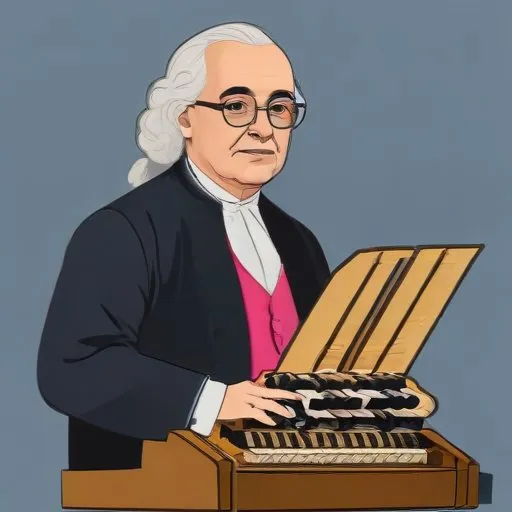
German Baroque-era organist and composer renowned for his intricate and expressive organ music, particularly his fugues and chorale preludes.
Johann Gottfried Vierling was a prolific German organist and composer, celebrated for his contributions to the world of music, particularly in the realm of organ composition. Born on January 25, 1750, in Metzels, Vierling's life was dedicated to the pursuit of creating beautiful music that would resonate with generations to come.
Vierling's early years were spent studying at the Lyzeum in Schmalkalden, where he honed his skills under the guidance of Johann Nikolaus Tischer. In 1768, he succeeded his teacher as organist in Schmalkalden, marking the beginning of a long and illustrious career. Vierling's desire for knowledge and growth led him to further his musical studies with prominent figures such as Carl Philipp Emanuel Bach and Johann Philipp Kirnberger.
Vierling's compositional repertoire is a testament to his mastery of the organ. He created several collections of easy organ pieces, a four-voice organ chorale book in 1790, and cembalo music, including two trios, one quartet, and six sonatas. Additionally, two handwritten annual volumes of Kirchenkantaten have been preserved, showcasing his versatility as a composer.
Among his notable works are:
Vierling's impact on the world of music extended beyond his compositions. He was a dedicated teacher, and one of his students, Johann Christian Friedrich Höffner, went on to become a renowned musician in Sweden. Vierling's contributions to the field of organ composition paved the way for future generations of musicians.
Vierling's life was marked by a passion for music and a commitment to sharing his knowledge with others. His legacy continues to inspire musicians and composers to this day, cementing his place as one of the most important figures in the history of German organ music.
Vierling passed away on November 22, 1813, in Schmalkalden, leaving behind a rich cultural heritage that continues to enrich the world of music.
Born in 1685
A renowned Baroque composer and organist, famous for creating majestic orchestral suites, operas, and oratorios, including the iconic "Messiah" masterpiece.
Born in 1685
A master of Baroque music, he composed over 1,000 works, including orchestral suites, cantatas, and passions, that still inspire and influence musicians today. His innovative use of counterpoint and harmony raised the bar for classical music.
Born in 1660
A renowned Baroque-era organist and composer, known for his innovative and expressive works that bridged the gap between the Renaissance and Baroque styles. His compositions showcased exceptional mastery of counterpoint and harmony.
Born in 1697
A renowned Baroque-era organist and composer, known for his contributions to the development of the organ concerto and his influential compositions for the instrument.
Born in 1683
A renowned Baroque composer and harpsichord virtuoso, known for his innovative and prolific output of orchestral suites, operas, and chamber music. His works showcase a unique blend of German and Italian styles.
Born in 1688
A German Baroque composer and violinist, known for his orchestral suites and contributions to the development of the concerto grosso form. His music bridged the styles of Bach and Handel.
Born in 1701
A renowned 18th-century opera composer and tenor, known for his innovative and expressive works that bridged the gap between Baroque and Classical styles. His compositions showcased exceptional vocal writing and dramatic flair.
