


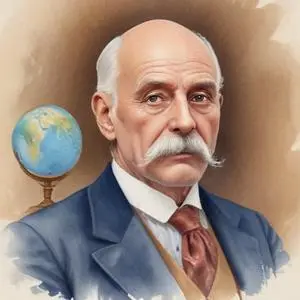
Developed the theory of intermolecular forces, which led to a better understanding of the behavior of gases and liquids, and was awarded the Nobel Prize in Physics in 1910.
Johannes Diderik van der Waals is renowned for his groundbreaking work on the equation of state for gases and liquids, earning him the 1910 Nobel Prize in Physics. His fundamental contributions to the field of thermodynamics and molecular science have left an indelible mark on our understanding of the physical world.
Born on November 23, 1837, in Leiden, Netherlands, Van der Waals began his academic journey as a schoolteacher. He later became the first physics professor of the University of Amsterdam in 1877, when the old Athenaeum was upgraded to a Municipal University.
Van der Waals' most significant achievement is the development of the Van der Waals equation of state, which describes the behavior of gases and their condensation to the liquid phase. This equation revolutionized the study of equations of state and provided a new framework for understanding the properties of fluids. The Van der Waals equation takes into account the finite volume occupied by molecules and the intermolecular interactions that govern their behavior.
Van der Waals' work also led to the discovery of Van der Waals forces, which are the weak intermolecular forces that arise between stable molecules. He introduced the concept of Van der Waals molecules, small molecular clusters bound by these forces, and Van der Waals radii, which describe the sizes of molecules.
Van der Waals' work was not without controversy. During his time, a strong philosophical current denied the existence of molecules, considering them unproven and unnecessary. However, Van der Waals' thesis affirmed the reality of molecules and allowed for an assessment of their size and attractive strength.
In the late 19th century, the molecular structure of fluids was not widely accepted, and liquid and vapor were often considered chemically distinct. Van der Waals' work changed this perception, providing a fundamental understanding of the behavior of fluids that has had a lasting impact on fields such as chemistry, physics, and engineering.
James Clerk Maxwell, a renowned physicist, once said, "There can be no doubt that the name of Van der Waals will soon be among the foremost in molecular science."
Van der Waals passed away on March 8, 1923, leaving behind a legacy that continues to inspire and influence scientists to this day.
Born in 1876
A Dutch physicist and academic who discovered superconductivity and was the first to solidify helium, making significant contributions to low-temperature physics.
Born in 1853
Discovered superconductivity, a phenomenon where certain materials exhibit zero electrical resistance at extremely low temperatures, revolutionizing the field of physics.
Born in 1865
A Dutch physicist who discovered the Zeeman effect, a phenomenon where spectral lines split into multiple components in a magnetic field, earning him a Nobel Prize in Physics in 1902.
Born in 1853
Developed the theory of electromagnetism, predicting the existence of radio waves and paving the way for Einstein's theory of relativity. Contributed to the understanding of light, space, and time.
Born in 1867
A pioneering scientist who pioneered radioactivity research, discovering elements polonium and radium, and paving the way for breakthroughs in medicine and energy.
Born in 1859
A pioneer in radioactivity research, discovering elements like polonium and radium, and pioneering radioactive isolation techniques. Their groundbreaking work paved the way for advancements in medicine, energy, and materials science.
Born in 1879
A brilliant physicist who developed the theory of relativity and is considered one of the most influential scientists of the 20th century, known for his groundbreaking work in physics and mathematics.
Born in 1885
A pioneer in quantum mechanics, he introduced the concept of wave-particle duality, revolutionizing our understanding of atomic structure. His philosophical approach to science also explored the nature of reality and human understanding.
