


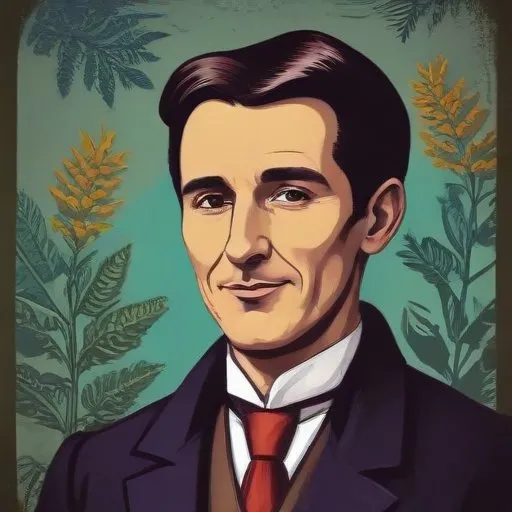
A pioneering physician and botanist who made significant contributions to the fields of medicine and botany, particularly in the discovery of new plant species and their medicinal properties.
John Fothergill was a renowned English physician, plant collector, philanthropist, and Quaker, best known for his influential medical writings and his contributions to the field of botany. As a pioneer in his field, Fothergill's work had a lasting impact on the medical community, and his passion for botany led to the creation of a sizeable botanical garden in West Ham Park, London.
Fothergill was born on March 8, 1712, at Carr End, near Bainbridge in Yorkshire, to John Fothergill, a Quaker preacher and farmer, and his first wife, Margaret Hough. He received his early education at Sedbergh School, before being apprenticed to an apothecary.
In 1736, Fothergill obtained the degree of Doctor of Medicine at the University of Edinburgh, followed by further studies at St. Thomas's Hospital, London. This solid foundation in medicine laid the groundwork for his future success as a physician.
Fothergill's medical writings were highly influential, and he was particularly known for his work on trigeminal neuralgia, angina, and diphtheria. His 1773 work, "Of a Painful Affection of the Face," is credited with first identifying and naming trigeminal neuralgia.
In addition to his written contributions, Fothergill was a hands-on physician, who treated a staggering 60 patients a day during the influenza epidemics of 1775 and 1776. His rejection of ineffective traditional therapies for diseases such as strep throat saved countless lives, earning him a reputation as a forward-thinking and compassionate doctor.
In his leisure time, Fothergill was an avid student of conchology and botany. In 1762, he purchased Upton House in West Ham, Essex, where he built an extensive botanical garden, featuring many rare plants obtained from around the world.
This botanical haven became a sanctuary for Fothergill, where he could escape the demands of his medical practice and indulge in his passion for nature. The garden remains a testament to his love of botany and his contributions to the field.
As a devout Quaker, Fothergill was deeply committed to philanthropy and social justice. He was a personal friend of Benjamin Franklin, and supported the publication of Franklin's papers on electricity, even writing a preface to the collection.
This friendship was not only a testament to Fothergill's intellectual curiosity but also his willingness to engage with prominent figures of his time, fostering a spirit of collaboration and mutual respect.
John Fothergill's contributions to medicine, botany, and philanthropy have had a lasting impact on modern society. His pioneering work in trigeminal neuralgia and his advocacy for effective treatments for diseases such as strep throat have saved countless lives.
As a Quaker, Fothergill's commitment to social justice and compassion continues to inspire future generations of physicians, botanists, and philanthropists. His legacy serves as a reminder of the importance of interdisciplinary collaboration and the power of human curiosity to drive progress and innovation.
Born in 1707
Developed the system of binomial nomenclature, which is still used today to classify and name living organisms. This system has had a profound impact on the fields of biology, ecology, and conservation.
Born in 1712
A pioneering thinker who shaped modern democracy and education with his ideas on social contracts, general will, and the importance of early childhood education. His writings influenced the French Revolution and modern political thought.
Born in 1668
A Dutch botanist and physician who laid the foundations for modern medicine by emphasizing clinical observation, experimentation, and scientific rigor, and is considered the father of physiology.
Born in 1728
Pioneering surgeon and anatomist who made groundbreaking discoveries in human anatomy, particularly in the field of venereal diseases, and was a pioneer in scientific surgery.
Born in 1710
Pioneering physician and chemist who discovered the properties of carbon dioxide and developed the theory of latent heat, making significant contributions to the fields of chemistry and medicine.
Born in 1728
Discovered magnesium and isolated carbon dioxide, making significant contributions to the field of chemistry.
Born in 1726
Pioneering geologist and physician who formulated the theory of uniformitarianism, proposing that the Earth's geological features were shaped by slow, gradual processes over millions of years.
Born in 1749
Developed the smallpox vaccine, revolutionizing disease prevention and saving countless lives.
