


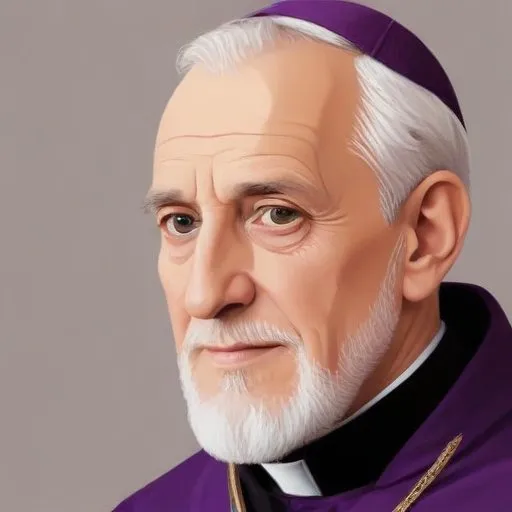
An Anglican cleric who served as the Bishop of Chelmsford from 1996 to 2009, known for his efforts in promoting social justice and interfaith dialogue.
John Gladwin, a renowned Anglican bishop, is revered for his remarkable service as the Bishop of Chelmsford from 2004 to 2009, and his profound impact on the Church of England. Throughout his illustrious career, he has been a beacon of hope, guiding countless individuals and communities with his unwavering commitment to the open evangelical tradition.
Born on May 30, 1942, in Hertford, Hertfordshire, England, Gladwin's early life was marked by a strong foundation in education. He attended Hertford Grammar School, an all-boys institution that instilled in him the values of discipline and intellectual curiosity. Later, he pursued his theological and historical studies at Churchill College, Cambridge, earning his BA in 1965 and MA in 1968. His academic pursuits continued at Cranmer Hall, Durham, where he obtained his Diploma in Theology in 1969, preparing him for ordination.
Gladwin's ordained ministry began in 1967, when he was ordained as a deacon, followed by his ordination as a priest in 1968. His early years of ministry saw him serving as a curate at St John the Baptist Parish Church, Kirkheaton, in the Diocese of Wakefield (1967-1971). This experience laid the groundwork for his subsequent roles, which would take him to Durham, where he became a tutor at St John's College and an honorary chaplain to students at St Nicholas Church (1971-1977).
Gladwin's commitment to social action led him to direct the Shaftesbury Project on Christian Involvement in Society (1977-1982), an initiative that sought to understand and promote Christian engagement in society. This period was followed by his role as secretary of the General Synod's Board for Social Responsibility (1982-1988), where he worked tirelessly to address pressing social issues. His dedication to the Church of England earned him the title of prebendary of St Paul's Cathedral in 1984.
In 1994, Gladwin was ordained as a bishop, beginning his tenure as the Bishop of Guildford. During this period, he demonstrated his exceptional leadership skills, guiding the diocese with wisdom and compassion. In 2004, he was appointed as the Bishop of Chelmsford, a role that would allow him to serve the second-largest diocese in the Church of England. Throughout his tenure, he worked to foster unity and diversity within the diocese, earning the respect and admiration of his peers.
After retiring as Bishop of Chelmsford in 2009, Gladwin continued to serve the Church of England, holding permission to officiate in the Diocese of St Albans since 2010. His remarkable life and ministry have left an indelible mark on the Anglican Church, inspiring generations of clergy and laity alike. John Gladwin's legacy serves as a testament to the power of faith, compassion, and dedication, reminding us of the profound impact one individual can have on the world.
Throughout his life, John Gladwin has embodied the spirit of servant leadership, exemplifying the values of kindness, empathy, and wisdom. His unwavering commitment to the Church of England has inspired countless individuals, and his legacy will continue to inspire future generations.
76 Years Old
A former Archbishop of Canterbury and prominent theologian, known for his progressive views on social issues and his efforts to promote interfaith dialogue.
90 Years Old
A prominent leader of the Church of England, serving as Archbishop of Canterbury from 1991 to 2002, known for his efforts to modernize the church and promote interfaith dialogue.
85 Years Old
An American composer and author who created an AI program called "Emily Howell" that composes music in various styles, blurring the lines between human and machine creativity. He's also written books on music and artificial intelligence.
Born in 1921
The 102nd Archbishop of Canterbury, a prominent leader of the Church of England, known for his efforts to promote unity and understanding among Christians and his role in shaping the church's stance on social issues.
Born in 1829
The Archbishop of Canterbury from 1883 to 1896, known for his efforts to reform the Church of England and strengthen its ties with the state. He was a key figure in shaping the church's role in British society.
