


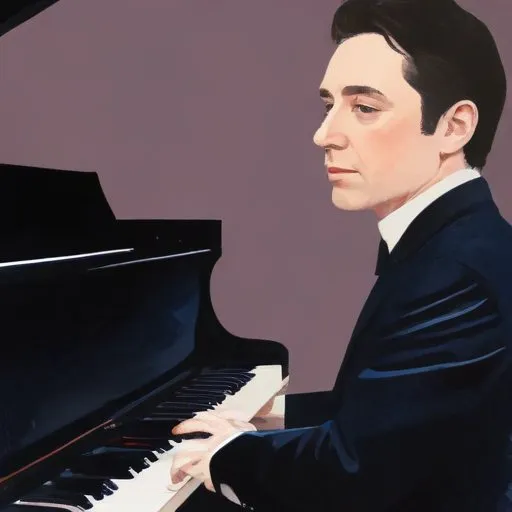
A pioneering figure in American music, known for blending jazz, classical, and folk styles, and leading the San Francisco Symphony Orchestra.
John J. Becker was a renowned American composer of contemporary classical music, pianist, conductor, writer on music, and music administrator. He is best known for his contributions to the development of American classical music, particularly in the early 20th century, and his tireless efforts to promote the works of his contemporaries.
Becker was born on January 22, 1886, in Henderson, Kentucky. He began his formal musical education at the Cincinnati Conservatory, receiving his diploma in 1905. He then pursued graduate studies at the Wisconsin Conservatory of Music in Milwaukee, where he earned a doctorate in composition in 1923.
Becker's career as an educator and administrator began in 1917 at the University of Notre Dame, where he taught for ten years. A devout Catholic, he relocated to another Catholic institution, the College of St. Thomas in St. Paul, Minnesota, where he taught from 1929 until 1933.
From 1935 to 1941, Becker administered the Federal Music Project in Minnesota, playing a crucial role in promoting American classical music during the Great Depression. During this period, he was also an associate editor of the New Music Quarterly, founded by Henry Cowell.
Becker returned to teaching at Barat College in Lake Forest, Illinois from 1943 until his retirement in 1957. His dedication to music education and administration left an indelible mark on the American classical music scene.
The John J. Becker Papers are held by the Music Division of the New York Public Library, a testament to his significant contribution to American classical music. Another collection, the Dr. John J. Becker (1886-1961) Papers, is held at the University of St. Thomas Libraries in Minnesota.
Becker's commitment to promoting American classical music led him to champion the works of his contemporaries, including Charles Ives, Carl Ruggles, and Wallingford Riegger. He premiered many of their works, contributing significantly to their recognition and acclaim.
Through his teaching, administrative roles, and compositional output, Becker played a vital role in shaping the course of American classical music in the early 20th century. His legacy continues to inspire generations of musicians and composers.
Becker was a devout Catholic and remained devoted to his faith throughout his life. He died on January 21, 1961, in Wilmette, Illinois, one day short of his 75th birthday.
In recognition of his contributions to music, Becker received numerous awards and honors, including the prestigious Ditson-Conductor's Award.
Today, Becker's music and legacy remain an integral part of American classical music heritage, a testament to his tireless dedication to promoting the art form he loved.
Born in 1897
A pioneering composer and pianist who experimented with avant-garde techniques, creating innovative works that blended traditional and modern styles. Known for his radical approach to music, pushing boundaries and inspiring future generations.
Born in 1874
A pioneer of American modernism, this composer blended traditional and experimental elements, creating a unique sound that defied conventions. He's most famous for his symphonies and piano sonatas.
Born in 1876
A pioneering avant-garde composer and painter, known for his innovative and dissonant music, as well as vibrant, abstract artworks.
Born in 1883
A pioneering composer who blended classical and modernist styles, creating innovative, avant-garde works that explored new sounds and techniques.
Born in 1874
A pioneer of atonality and 12-tone serialism, revolutionizing classical music with innovative compositions that pushed boundaries of harmony and melody.
92 Years Old
A controversial radio host and lawyer who sparked heated debates with his outspoken views, ultimately becoming a martyr for free speech after a tragic assassination.
Born in 1883
A pioneering figure in atonality and twelve-tone technique, revolutionizing classical music with concise, expressive works that explored new sounds and structures.
Born in 1908
A pioneering composer of modern classical music, known for his complex and innovative works that pushed the boundaries of harmony and rhythm.
