


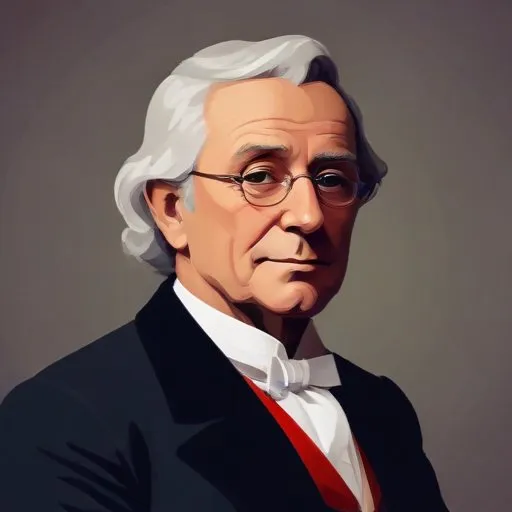
A pioneering avant-garde composer and painter, known for his innovative and dissonant music, as well as vibrant, abstract artworks.
Carl Ruggles, born Charles Sprague Ruggles, was a renowned American composer, painter, and teacher, best known for his contributions to the ultramodernist movement in music. His groundbreaking compositions, characterized by dissonant counterpoint, have left an indelible mark on the world of classical music.
Ruggles was born on March 11, 1876, in Marion, Massachusetts, to Nathaniel Ruggles and Maria Josephine Ruggles. His family's rich history in Massachusetts dates back to the 17th century, with many ancestors holding prominent military and political positions. This strong sense of heritage likely influenced Ruggles' pursuit of artistic excellence.
Ruggles' music defied conventional norms, embracing dissonance and atonality. He developed a unique technique of nonserial atonal counterpoint, which involved avoiding the repetition of pitch classes until a fixed number of eight pitch classes intervened. This innovative approach earned him recognition as a founder of the ultramodernist movement, alongside Henry Cowell and Ruth Crawford Seeger.
Despite his lack of formal musical education, Ruggles was an extreme perfectionist, crafting his pieces at a painstakingly slow rate. This dedication resulted in a relatively small but significant output, leaving behind a legacy that continues to inspire contemporary composers.
In addition to his musical accomplishments, Ruggles was also a prolific painter. He created hundreds of works during his lifetime, showcasing his artistic versatility. His paintings often featured vibrant colors and abstract forms, reflecting the same rebellious spirit that characterized his music.
Ruggles' prickly personality notwithstanding, he formed close bonds with fellow artists, including Henry Cowell, Ruth Crawford Seeger, Edgard Varèse, Charles Ives, and Thomas Hart Benton. His students, such as James Tenney and Merton Brown, went on to become prominent experimental composers in their own right.
Ruggles' music has been championed by conductors like Michael Tilson Thomas, who has recorded his complete works with the Buffalo Philharmonic. The San Francisco Symphony has also performed his iconic piece, "Sun-Treader", cementing Ruggles' place in the pantheon of American classical music.
Ruggles' life was marked by a fierce dedication to his art, as evident in his quote: "I am not interested in music that is agreeable to the ear, but in music that is disagreeable."
Throughout his life, Ruggles remained true to his artistic vision, refusing to compromise his unique style. This unwavering commitment has inspired generations of composers, painters, and musicians, solidifying his place as a trailblazer in American classical music.
Born in 1874
A pioneer of American modernism, this composer blended traditional and experimental elements, creating a unique sound that defied conventions. He's most famous for his symphonies and piano sonatas.
Born in 1897
A pioneering composer and pianist who experimented with avant-garde techniques, creating innovative works that blended traditional and modern styles. Known for his radical approach to music, pushing boundaries and inspiring future generations.
Born in 1883
A pioneering composer who blended classical and modernist styles, creating innovative, avant-garde works that explored new sounds and techniques.
Born in 1874
A pioneer of atonality and 12-tone serialism, revolutionizing classical music with innovative compositions that pushed boundaries of harmony and melody.
84 Years Old
A visionary musician and producer who co-founded The Velvet Underground, pushing boundaries in rock music and influencing generations of artists. Known for experimental and avant-garde work .
Born in 1908
A pioneering composer of modern classical music, known for his complex and innovative works that pushed the boundaries of harmony and rhythm.
Born in 1926
A pioneer of indeterminacy in music, creating subtle, atmospheric soundscapes that defy traditional composition, and teaching generations of musicians to think outside the box.
Born in 1879
A modernist master of language and imagination, crafting innovative, symbolic poetry that explores the human experience and the relationship between reality and the individual's perception of it.
