


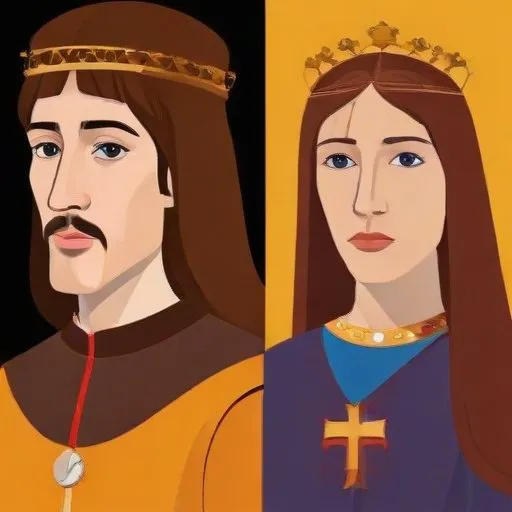
The son of the Catholic Monarchs, he was the heir to the Spanish throne and a symbol of the unified kingdom of Spain. He died young, sparking a succession crisis.
John, Prince of Asturias, was the sole heir to the thrones of Aragon and Castile, born to the powerful Catholic Monarchs, King Ferdinand II of Aragon and Queen Isabella I of Castile. As the only son of the royal couple, John's life was marked by his destiny to rule Spain, and his upbringing was carefully guided by his parents to prepare him for the monumental task.
John was born in Seville on June 30, 1478, during the midst of the War of Castilian Succession. His birth played a significant role in consolidating his mother's position as a sovereign, and he had one elder sister, Isabella, and three younger sisters, Joanna, Maria, and Catherine. The Catholic Monarchs won the war against the King and Queen of Portugal, and John's life was intricately tied to the politics of the time.
As a child, John's health was a major concern for his parents. He was of delicate health, and his parents went to great lengths to ensure his wellbeing. They employed the services of two wet nurses, Maria de Guzman and Juana de Torres, who played a crucial role in his upbringing. Juana de Torres remained by John's side well into his adolescence, possibly due to his continued frail health.
Isabella I was a devoted mother, and she took great care in educating her son. John was tutored in the arts of war, politics, and governance, preparing him for his future role as king. His parents also instilled in him a strong sense of morality and faith, seeking to create a just and fair ruler.
John's parents attempted to ensure his health and wellbeing through prayer, charity, and careful oversight of his health. They referred to him affectionately as "my angel," even when he was being reprimanded for his actions. This nickname highlights the special place John held in his parents' hearts.
John's life was cut short when he died on October 4, 1497, at the age of 19. His death was a devastating blow to his parents, who had pinned their hopes on him to secure their legacy. Despite his short life, John played a significant role in Spanish history, and his legacy continues to be felt today.
John's life serves as a testament to the political turmoil of the time and the importance of the Catholic Monarchs' efforts to unite Spain. His story is a fascinating glimpse into the intrigue and politics of the royal courts of 15th-century Spain.
John's life was marked by several key events that shaped his destiny and legacy. Some of the most significant milestones include:
John, Prince of Asturias, may have lived a short life, but his impact on Spanish history is undeniable. His story serves as a fascinating testament to the intrigue and politics of the royal courts of 15th-century Spain.
Born in 1451
Unified the Spanish kingdoms, sponsored Christopher Columbus's voyage to the Americas, and established the Spanish Inquisition.
Born in 1380
Unified the Crown of Aragon, ruling over a vast territory in eastern Spain, and sponsored the voyages of Christopher Columbus, leading to the discovery of the New World.
Born in 1350
King of Aragon from 1387 to 1396, known for his tumultuous reign marked by conflicts with the nobility and the papacy. He was also a patron of the arts and literature.
Born in 1424
Queen of Navarre from 1461 to 1464, known for her brief and tumultuous reign, marked by conflicts with her brother and husband.
Born in 1338
The King of France from 1364 to 1380, known for his military victories and rebuilding of Paris, earning him the nickname "Charles the Wise".
Born in 1516
The first queen to rule England in her own right, Bloody Mary tried to restore Catholicism, earning her notorious reputation for burning hundreds of Protestants at the stake.
