


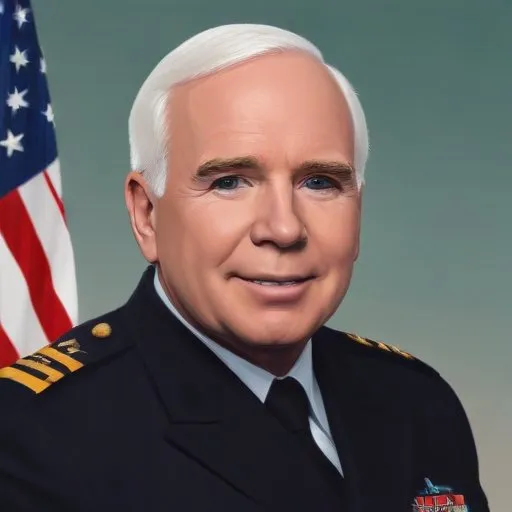
A four-star admiral who played a significant role in the Pacific Theater during World War II, later serving as the Commander-in-Chief of the U.S. Pacific Command. He was also the father of Senator John McCain.
John S. McCain Jr. is best known for his illustrious naval career, which spanned multiple conflicts and left an indelible mark on American military history. As a steadfast anti-communist and ardent promoter of naval power, McCain earned the nickname "Mr. Seapower," solidifying his position as a prominent figure in American defense policy.
Born on January 17, 1911, to a naval officer, John S. McCain Sr., in Washington, D.C., McCain's path was all but certain. He graduated from the U.S. Naval Academy in 1931, embarking on a journey that would take him to the pinnacle of naval command.
During World War II, McCain commanded submarines in multiple theaters, claiming several Japanese ships as his victories. His bravery and tactical prowess earned him the Silver Star and Bronze Star decorations. After the war, he continued to hold various commands, specializing in amphibious warfare and contributing to the development of the U.S. Navy's amphibious capabilities.
As Commander-in-Chief, Pacific Command (CINCPAC) from 1968 to 1972, McCain played a crucial role in the Vietnam War, supporting President Richard Nixon's policy of Vietnamization. His advocacy for a strong naval presence in the region contributed to the 1970 Cambodian Incursion, a decision that would have far-reaching repercussions. McCain also backed the 1971 incursion into Laos, further cementing his reputation as a hawkish military leader.
McCain's father, Admiral John S. McCain Sr., was a naval aviator and Task Force commander. Together, they formed the first father-son duo to achieve a four-star rank in the U.S. Navy. His son, John S. McCain III, would follow in his footsteps, becoming a naval aviator, prisoner of war, and eventually, a United States senator and presidential candidate.
John S. McCain Jr.'s unwavering commitment to the U.S. Navy and his advocacy for seapower have left an indelible mark on American military history. His legacy extends beyond his own accomplishments, as his influence can be seen in the careers of his family members and the countless lives he touched throughout his storied career.
Born in 1911
A four-star admiral who played a significant role in the Pacific Theater during World War II, later serving as the Commander-in-Chief of the U.S. Pacific Command. He was also the father of Senator John McCain.
Born in 1917
The 35th President of the United States was a charismatic leader who navigated the country through the Cuban Missile Crisis and advocated for civil rights, leaving a lasting legacy in American politics.
Born in 1908
The 36th President of the United States, a skilled politician and leader, played a crucial role in passing landmark civil rights legislation, including the Civil Rights Act and Voting Rights Act.
Born in 1913
The 37th President of the United States, a polarizing figure who led the country through significant domestic and foreign policy changes, infamous for his involvement in the Watergate scandal.
Born in 1913
The 38th President of the United States, a former football star and lawyer, is known for being the first vice president to assume the presidency under the 25th Amendment and for his controversial pardon of Richard Nixon. He's also remembered for his humble and accidental rise to the presidency.
Born in 1924
A naval officer turned politician who served as the 39th President of the United States, known for his commitment to human rights and social justice, and awarded the Nobel Peace Prize in 2002.
Born in 1911
The charismatic leader who championed conservative policies, helped end the Cold War, and is often credited with restoring American pride and optimism. He's also remembered for his folksy, actor-honed communication style.
Born in 1924
The 41st President of the United States, a decorated war hero and skilled diplomat, led the country through the end of the Cold War and Gulf War. He's known for his foreign policy expertise and "kinder, gentler nation" vision.
