


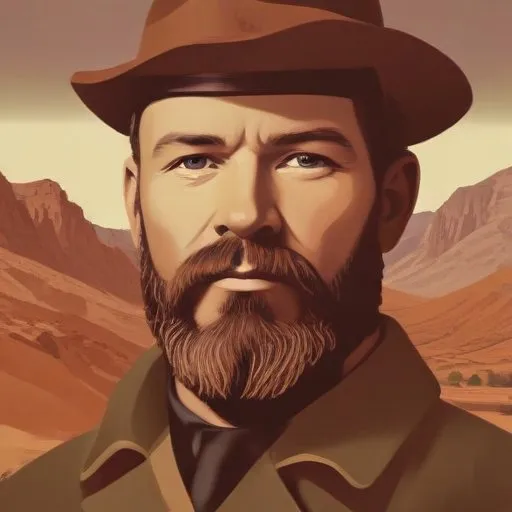
Led a groundbreaking expedition down the Colorado River, mapping the Grand Canyon and making significant geological discoveries. He's considered one of the most important figures in the exploration of the American West.
John Wesley Powell is renowned for his groundbreaking 1869 expedition, a three-month river trip down the Green and Colorado rivers, including the first official U.S. government-sponsored passage through the Grand Canyon. This perilous journey not only opened the eyes of the world to the vast, uncharted territories of the American West but also cemented Powell's status as a pioneering geologist and explorer.
Born on March 24, 1834, in Mount Morris, New York, Powell's early life was marked by a sense of adventure and a thirst for knowledge. His family's westward migration to Jackson, Ohio, and later to Walworth County, Wisconsin, and Boone County, Illinois, instilled in him a deep appreciation for the natural world and its wonders.
Powell's exploratory endeavors were complemented by his scientific pursuits. He studied at Illinois College, Illinois Institute (now Wheaton College), and Oberlin College, laying the foundation for his future work as a geologist and ethnologist.
During his tenure as USGS director, Powell proposed policies for the development of the arid West, which were prescient in their accurate evaluation of environmental conditions. His leadership also oversaw the creation of the Irrigation Survey, a landmark study that laid the groundwork for water resource management in the western United States.
Through his work, Powell left an indelible mark on the fields of geology, ethnology, and exploration. His expeditions, writings, and research continue to inspire generations of scientists, explorers, and environmentalists, cementing his place as one of the most influential figures in the history of American science.
"The wonders of the Grand Canyon cannot be adequately represented in symbols of speech, nor by paintings, although these may convey some sense of the awe-inspiring grandeur of this natural wonder."
These words, spoken by Powell himself, encapsulate the sense of wonder and awe that defined his life's work, and continue to inspire those who follow in his footsteps.
Born in 1813
American general, explorer, and politician who played a key role in the westward expansion of the United States, particularly in the Arizona Territory. He's also known for being one of the first presidential candidates of the Republican Party.
Born in 1809
Famous frontiersman and explorer who led expeditions through the American West, known for his bravery and role in the Mexican-American War.
Born in 1839
Led a cavalry regiment in the American Civil War and Indian Wars, ultimately meeting defeat at the Battle of Little Bighorn. He's infamous for his last stand against the Lakota, Cheyenne, and Arapaho tribes.
Born in 1820
A renowned Union general during the American Civil War, he's infamous for his scorched earth tactics and march through the Confederacy, leaving destruction in his wake.
Born in 1822
Led the Union Army to victory in the Civil War and later became President, known for issuing the Emancipation Proclamation and strengthening federal authority.
Born in 1807
Led the Confederate States Army during the American Civil War, surrendering to Union forces at Appomattox, marking the war's effective end.
Born in 1826
A Union general during the American Civil War, he's infamous for his cautious tactics and disagreements with President Lincoln, later becoming a governor of New Jersey.
Born in 1809
Led the United States through its Civil War and ultimately abolished slavery, leaving a lasting legacy in American history.
