


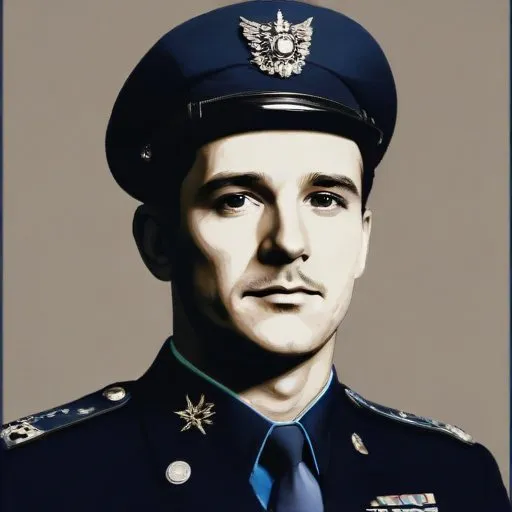
A Medal of Honor recipient and lieutenant who displayed extraordinary heroism during the attack on Pearl Harbor, earning the nation's highest military honor for his bravery.
John William Finn is renowned for receiving the United States military's highest decoration, the Medal of Honor, for his extraordinary bravery during the attack on Pearl Harbor in World War II. On December 7, 1941, Finn, a chief petty officer and aviation ordnanceman, demonstrated unwavering courage by firing a machine gun from an exposed position throughout the attack, despite being repeatedly wounded.
Finn was born on July 24, 1909, in Compton, California. He dropped out of school after the seventh grade and enlisted in the Navy in July 1926, shortly before his seventeenth birthday. After completing recruit training in San Diego, he attended General Aviation Utilities Training at Naval Station Great Lakes, graduating in December 1926.
Finn's naval career spanned over three decades, during which he served on several ships, including USS Lexington, USS Houston, USS Jason, USS Saratoga, and USS Cincinnati. He was promoted to chief petty officer (E7), the highest enlisted rank in the Navy at the time, in 1935 after only nine years of active duty.
On December 7, 1941, Finn's Naval Air Station Kaneohe Bay was attacked by the Japanese. Despite being wounded multiple times, he refused to retreat, firing a machine gun from an exposed position to defend his comrades. His selfless actions inspired others to continue fighting, and his bravery undoubtedly saved numerous lives.
Finn's Medal of Honor citation reads: "For extraordinary heroism, distinguished service, and devotion above and beyond the call of duty. During the first attack by Japanese airplanes on the Naval Air Station, Kaneohe Bay, on 7 December 1941, Chief Finn, after being wounded, repeatedly returned to the machine gun and continued to fire at the enemy until ordered to leave."
After receiving the Medal of Honor, Finn continued to serve in the Navy, eventually rising to the rank of lieutenant before retiring in 1956. In his later years, he made numerous appearances at events celebrating veterans, inspiring generations with his courage and dedication.
At the time of his passing on May 27, 2010, Finn was the oldest living Medal of Honor recipient, the last living recipient from the attack on Pearl Harbor, and the last living United States Navy recipient of World War II.
John William Finn's remarkable story serves as a testament to the bravery and selflessness of those who serve in the armed forces. His legacy continues to inspire generations, reminding us of the importance of courage, duty, and sacrifice.
Born in 1885
Led the U.S. Pacific Fleet to victory in World War II, playing a crucial role in defeating Japan and ending the war. He was a highly respected and decorated naval leader.
Born in 1890
Led the Allied forces to victory in World War II and later served as President, maintaining peace and prosperity during the Cold War era. He's known for his strategic leadership and diplomatic skills.
Born in 1885
A renowned military leader who played a crucial role in World War II, particularly in the Allied victory in Europe, known for his bold tactics and unapologetic style.
Born in 1880
A highly decorated war hero and master strategist who led troops to victory in World War I and II, and later became a prominent figure in the occupation of Japan.
Born in 1922
A Japanese Imperial Army intelligence officer who refused to surrender after World War II, holding out in the jungle for 29 years, believing the war was still ongoing. He finally surrendered in 1974, becoming an international sensation.
Born in 1925
A decorated war hero and Hollywood star, known for bravery in World War II and starring in films like "The Red Badge of Courage" and "To Hell and Back".
Born in 1916
A Marine sergeant who received the Medal of Honor for his heroic actions during World War II, particularly in the Battle of Guadalcanal. He's known for his bravery and selflessness in the face of overwhelming enemy fire.
