


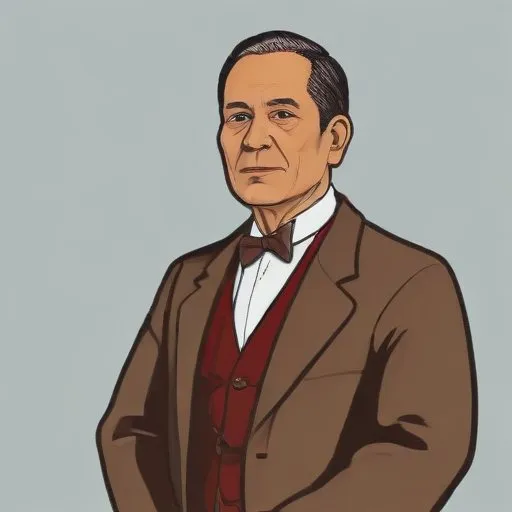
Peruvian historian who wrote extensively on the country's history, particularly the 19th century, and is considered one of the most important historians of Peru. His works are still widely read and studied today.
Jorge Basadre, a luminary in the realm of Peruvian historiography, is renowned for his exhaustive publications that shed light on the intricate tapestry of his country's independent history. His work has left an indelible mark on the understanding of Peru's past, earning him the reputation as one of the most prolific historians of his time.
Born on February 12, 1903, in Tacna, Peru, Basadre's early life was marked by a strong sense of national pride, courtesy of his great-grandfather, Jos Toribio Ara y Cceres, a cacique who fought in the Peruvian War of Independence. This heritage would later influence his academic pursuits and professional endeavors.
Basadre's educational journey began at the Liceo Santa Rosa, a Peruvian school in Tacna, which he attended until his family relocated to Lima in 1912. He then enrolled in the German School of Lima, before moving on to the College of Our Lady of Guadalupe in 1918 to complete his secondary education.
In 1919, Basadre enrolled in the National University of San Marcos, where he earned a Ph.D. in Humanities in 1928 and a law degree in 1935. During his time at the university, he actively participated in the University Conversation of 1919, a movement led by young students advocating for reforms.
Basadre's academic excellence and passion for history led to his appointment as a professor at the Universidad Nacional Mayor de San Marcos in 1928, where he taught a course on the History of Peru. In 1929, he took on the titular chair of History of the Republic of Peru, a position he held until 1954, with brief intervals abroad.
In the early 1930s, Basadre received a scholarship from the Carnegie Institution to pursue postgraduate studies in the United States. He also spent time in Germany, where he attended the Humboldt University of Berlin. During this period, he traveled to Spain to conduct research in archives at the University of Seville.
Basadre's research and academic pursuits led to his appointment as the director of the Peruvian National Library, a role he held during two different administrations. He also served as the Minister of Education during this time, further solidifying his influence on Peru's educational landscape.
Jorge Basadre's tireless efforts to chronicle and analyze Peru's history have left an enduring legacy in the field of historiography. His extensive publications have provided a rich tapestry of knowledge, illuminating the complex nuances of Peru's past.
Through his work, Basadre has inspired generations of historians, scholars, and researchers, ensuring that the intricacies of Peru's history remain an integral part of the country's cultural heritage.
Born in 1911
A Peruvian anthropologist, author, and poet who explored the cultural heritage of indigenous peoples through his literature, blending traditional Andean storytelling with modernist techniques. He's most known for his novels that give voice to the marginalized and oppressed.
90 Years Old
A Nobel Prize-winning writer and politician who explored the complexities of Peruvian society through his novels and essays, and later ran for president. His works often blended politics, history, and fiction.
Born in 1895
Founded the American Popular Revolutionary Alliance, a political party that aimed to unite Latin American countries and promote social and economic reform, playing a significant role in Peruvian politics.
Born in 1894
Peruvian journalist, politician, and philosopher who founded the Socialist Party of Peru and is considered one of the most influential Latin American thinkers of the 20th century.
Born in 1892
A pioneering poet who revolutionized Spanish-language literature with innovative, avant-garde styles and socially conscious themes. His works explored the human condition, politics, and social justice.
