


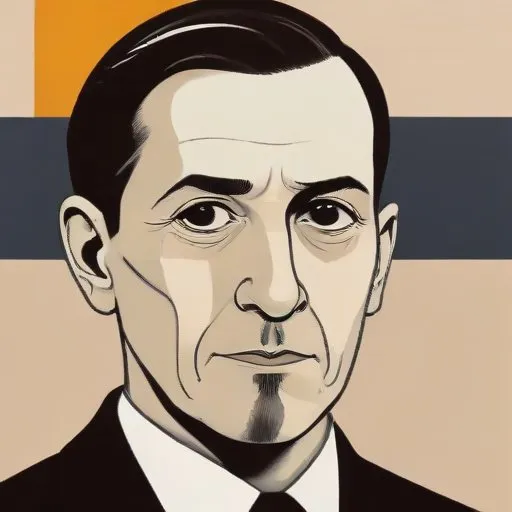
Czech architect who designed iconic buildings in Prague, blending Cubism and Functionalism, creating a unique style that shaped the city's landscape.
Josef Gor, a pioneer of modern architecture in the Czech Republic, left an indelible mark on the world of design and construction. As one of the founders of modern architecture in his country, Gor's innovative style and contributions continue to inspire architects and designers to this day.
Born on March 13, 1880, in Semn, Gor received his early instruction at the State Technical School in Prague. At the age of 23, he went on to study under the renowned architect Jan Kotra at the School of Applied Arts in Prague. This period of study laid the foundation for Gor's future success, and his work would eventually surpass that of his mentor.
In 1906-1908, Gor worked in Kotra's studio, honing his skills and developing his own unique style. He then joined the Mnes Union of Fine Arts, only to leave in 1911 and join the Cubist Group of Visual Artists. This bold move marked the beginning of Gor's exploration of Cubism, a style that would shape his architecture and designs for years to come.
In 1912, Gor, along with Pavel Jank, Josef Chochol, and Odolen Grgr, founded the Prague Art Workshops. This collective aimed to promote innovation and artistic expression in architecture and design. The Workshops became a hub for creative minds, and Gor's involvement played a significant role in shaping the country's architectural landscape.
In the early 1920s, Gor turned his attention to national Czech Rondocubism, a style that blended Cubist principles with traditional Czech motifs. However, he soon adopted the Functionalist approach to architecture, which emphasized simplicity, functionality, and minimalism. This shift marked a significant turning point in Gor's career, and his work would never be the same.
Gor's most notable achievement is arguably the Czechoslovak Pavilion for the 1925 Exposition internationale des arts dcoratifs et industriels modernes in Paris. This masterpiece earned him the Grand Prize, solidifying his reputation as a leading architect. In 1926, he was awarded the Ordre de la Lgion dhonneur, further cementing his status as a master of modern architecture.
Josef Gor's contributions to modern architecture are undeniable. His innovative style, which blended Cubism, Rondocubism, and Functionalism, continues to inspire architects and designers today. His legacy extends beyond his own country, as his work has influenced architectural movements around the world.
Gor's influence on modern society is palpable, as his designs have become an integral part of the Czech Republic's cultural heritage. His commitment to innovation and artistic expression has left an indelible mark on the world of architecture.
Josef Gor passed away on September 10, 1945, in Jin, but his work continues to inspire and awe people around the world. His legacy serves as a testament to the power of innovation and creativity, and his contributions to modern architecture will forever be remembered.
Gor's story is a reminder that even the most unlikely of individuals can leave an indelible mark on the world. His journey from humble beginnings to international recognition is a testament to the power of hard work, dedication, and a passion for creativity.
Born in 1876
A renowned pianist and composer, known for his breathtaking technique and poetic interpretations of Chopin's works. He was also a pioneer in piano pedagogy, leaving a lasting legacy in music education.
Born in 1870
A pioneer of modern architecture, he rejected ornate decorations, advocating for simplicity and functionality, influencing the development of modernist design.
