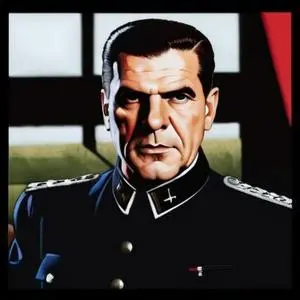
The Angel of Death: Unveiling the Twisted Legacy of Josef Mengele
The Infamous Doctor of Auschwitz
Josef Mengele, a German Schutzstaffel (SS) officer and physician, earned the notorious moniker "Angel of Death" for his inhumane experiments on prisoners at Auschwitz II-Birkenau concentration camp during World War II. As a member of the team of doctors who selected victims for the gas chambers, Mengele's actions were nothing short of genocidal.
Early Life and Education
Born on March 16, 1911, in Günzburg, Bavaria, Germany, Mengele was raised in a Catholic family. He pursued higher education, earning doctorates in anthropology and medicine from the University of Munich. His academic background laid the groundwork for his later "research" at Auschwitz.
Rise to Notoriety
Mengele joined the Nazi Party in 1937 and the SS in 1938. At the outbreak of World War II, he was assigned as a battalion medical officer. In early 1943, he was transferred to the Nazi concentration camps service, where he saw an opportunity to conduct genetic research on human subjects at Auschwitz. His twisted fascination with twins led him to perform heinous experiments, disregarding the health and safety of his victims.
The Auschwitz Years
During his time at Auschwitz, Mengele's atrocities knew no bounds. He was responsible for selecting prisoners for the gas chambers, as well as conducting gruesome experiments on twins, dwarves, and people with other physical abnormalities. His "research" was driven by a pseudoscientific obsession with racial purity and a desire to understand the genetics of twinning.
Escape and Evasion
As the Red Army closed in on Auschwitz in January 1945, Mengele fled to the Gross-Rosen concentration camp. After the war, he escaped to Argentina in July 1949, where he lived under the radar, assisted by a network of former SS members. He later moved to Paraguay in 1959 and Brazil in 1960, evading capture despite international efforts to bring him to justice.
A Life on the Run
Mengele's post-war existence was marked by secrecy and deception. He assumed various aliases, including Wolfgang Gerhard, and led a relatively quiet life, albeit under constant fear of detection. Despite being pursued by West Germany, Israel, and Nazi hunters like
Simon Wiesenthal, Mengele managed to evade capture for over three decades.
Death and Legacy
On February 7, 1979, Mengele's life came to an end when he suffered a stroke while swimming off the coast of Bertioga, Brazil, and drowned. His remains were buried under his assumed identity until they were exhumed and positively identified by forensic examination in 1985. Mengele's twisted legacy serves as a grim reminder of the atrocities committed during the Holocaust, and the importance of remembering the victims of his brutal experiments.
- Notable Quote: "I do not remember ever seeing a doctor as meticulously dressed as Mengele. He looked like he just stepped out of a fashion magazine." - Auschwitz survivor, Dr. Gisella Perl
- Influenced by the Nazi ideology of racial purity, Mengele's experiments were driven by a belief in the superiority of the Aryan race.
- His actions at Auschwitz led to the deaths of thousands of innocent people, earning him a place among the most reviled figures in human history.
FAQ
What was Josef Mengeles role in the Holocaust?
Josef Mengele was a German physician and captain who conducted inhumane and deadly experiments on prisoners at Auschwitz concentration camp during World War II.
What kind of experiments did Josef Mengele conduct?
Josef Mengele conducted brutal and inhumane experiments on twins, dwarves, and people with disabilities, often resulting in their death or permanent disfigurement.
How did Josef Mengele escape prosecution?
Josef Mengele escaped prosecution by fleeing to South America, where he lived in hiding for the rest of his life, evading capture and justice for his crimes.
What was Josef Mengeles early career like?
Josef Mengele started his career as a physician, earning a Ph.D. in anthropology and working in a hospital before joining the Nazi Party and becoming involved in the Holocaust.
What was Josef Mengeles ultimate fate?
Josef Mengele drowned in 1979 while swimming in Brazil, avoiding justice for his crimes until the end of his life.