


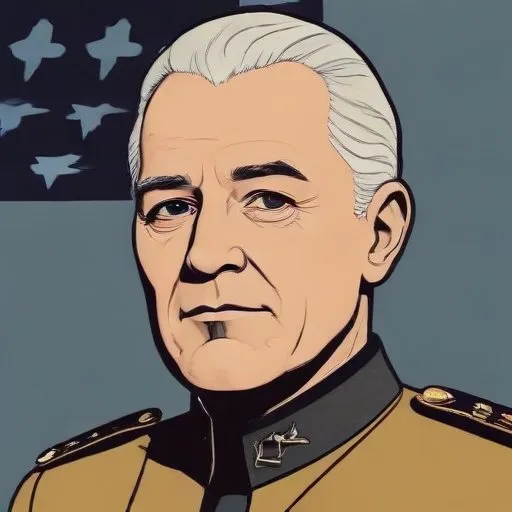
A decorated military leader who served as the Chief of Staff of the United States Army during World War II, playing a crucial role in planning and executing major military operations.
Joseph Carroll is best known as the founding director of the Defense Intelligence Agency (DIA) and the first commander of the U.S. Air Force Office of Special Investigations (AFOSI or OSI). His remarkable career spanned decades, leaving an indelible mark on the intelligence community and national security.
Born on March 19, 1910, in Chicago, Illinois, Carroll graduated from St. Mary of the Lake Seminary in Mundelein, Illinois, in 1933 with a Bachelor of Arts degree. He then earned a J.D. degree from Loyola University in 1940.
Carroll's journey took an unexpected turn when he left the Seminary of St. Mary on the eve of being ordained a deacon. This decision allowed him to pursue a relationship with Mary Morrissey, who would become his wife. After working as an assistant sales manager at Swift and Company, a meatpacking concern in Chicago, Carroll joined the Federal Bureau of Investigation (FBI) in October 1940.
During his time in the FBI, Carroll served as a special agent in field offices at Memphis and Knoxville, Tennessee, before being assigned to the Chicago field office. His instrumental role in capturing notorious gangster Roger "Tough" Touhy brought him to the personal attention of FBI Director J. Edgar Hoover. Carroll's progressive positions within the FBI included supervisor in charge of bank robbery and kidnapping matters, chief of the Criminal Section, and first assistant to the assistant director of the FBI in charge of the General Investigations and Accounting Division.
In 1961, Carroll became the founding director of the Defense Intelligence Agency (DIA), merging the intelligence elements of the Army, Navy, and Air Force. This consolidation aimed to enhance the accuracy and efficiency of military intelligence, ultimately strengthening national security.
Throughout his illustrious career, Carroll's leadership and vision have had a profound impact on the intelligence community. He played a pivotal role in shaping the Defense Intelligence Agency, leaving behind a legacy of excellence and dedication to national security.
Carroll was survived by his wife, Mary, and five sons, including former priest and writer James Carroll. He remained a member of the Illinois State Bar Association from 1940 until his passing on January 20, 1991.
"The most effective intelligence is that which is shared and acted upon in a timely manner." - Joseph Carroll
Joseph Carroll's remarkable career spanned a critical period in American history, from World War II to the Cold War era. His contributions to the intelligence community have had a lasting impact on national security, cementing his legacy as a visionary leader and pioneer in the field of intelligence.
Born in 1890
Led the Allied forces to victory in World War II and later served as President, maintaining peace and prosperity during the Cold War era. He's known for his strategic leadership and diplomatic skills.
Born in 1893
Led the US Army in World War II and became the last five-star general, playing a crucial role in shaping post-war American military strategy. He's also known for his humble and unassuming leadership style.
Born in 1885
A renowned military leader who played a crucial role in World War II, particularly in the Allied victory in Europe, known for his bold tactics and unapologetic style.
Born in 1906
A pioneering Air Force general who played a crucial role in shaping the US military's strategic bombing capabilities during World War II and the Cold War. He's also known for his hawkish stance on communism and his influence on US foreign policy.
Born in 1891
Led the US Air Forces to victory in World War II, pioneering the use of strategic bombing and playing a crucial role in shaping the US military's air power.
Born in 1896
Led a daring bombing raid on Tokyo in 1942, earning the Medal of Honor for his bravery and helping to turn the tide of World War II.
