


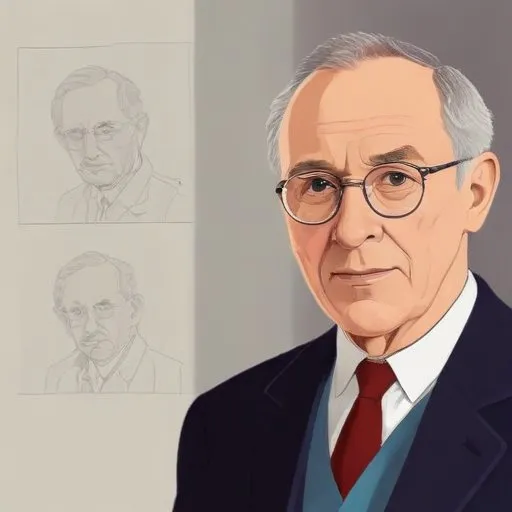
A pioneering physiologist who discovered the nervous system's ability to regulate heart rate, earning a Nobel Prize in Physiology or Medicine in 1944. His work laid the foundation for modern cardiac therapy.
Joseph Erlanger, an American physiologist, is renowned for his groundbreaking contributions to the field of neuroscience, particularly in the identification of various nerve fiber types and the correlation between action potential velocity and fiber diameter.
Born on January 5, 1874, in San Francisco, California, Erlanger was the sixth of seven children to Jewish parents who had immigrated from the Kingdom of Wrttemberg, Germany during the Gold Rush. He pursued his undergraduate degree in chemistry from the University of California, Berkeley, graduating in 1895. Erlanger then went on to earn his M.D. from the Johns Hopkins School of Medicine in Baltimore, Maryland, in 1899, finishing second in his class.
After completing his internship at Johns Hopkins Hospital under the guidance of William Osler, Erlanger worked in a physiology laboratory, where he developed a strong interest in cardiology. His research on the transfer of excitation from the atrium to the ventricle, conducted alongside Arthur Hirschfelder, laid the foundation for his future work.
In 1901, Erlanger published a paper on the digestive systems of canines, which caught the attention of William Henry Howell, a physiology professor at Johns Hopkins School of Medicine. Howell recruited Erlanger as an Assistant Professor, and he was later promoted to Associate Professor before 1906. During this period, Erlanger developed and patented a new type of sphygmomanometer that could measure blood pressure from the brachial artery.
In 1906, Erlanger accepted the position of the first chair of physiology at the University of Wisconsin in Madison. He later moved to Washington University in St. Louis in 1910, where he served as a professor. It was during this time that Erlanger, along with Herbert Spencer Gasser, embarked on his most significant research, which ultimately led to their Nobel Prize in Physiology or Medicine in 1944.
The Nobel Committee recognized Erlanger and Gasser's pioneering work, which identified several varieties of nerve fiber and established the relationship between action potential velocity and fiber diameter. This groundbreaking discovery revolutionized the field of neuroscience, paving the way for future research and advancements.
Throughout his life, Erlanger was driven by a passion for research and a commitment to advancing the field of neuroscience. His remarkable contributions continue to inspire scientists and researchers, cementing his legacy as one of the most influential physiologists of the 20th century.
As we reflect on Erlanger's life and achievements, we are reminded of the power of dedication, perseverance, and collaboration in pushing the boundaries of human knowledge.
Born in 1888
A pioneering physiologist who discovered the different roles of nerve fibers in transmitting sensory information, earning him a Nobel Prize in Physiology or Medicine in 1944.
Born in 1857
A pioneering scientist who made groundbreaking discoveries in the fields of physiology, bacteriology, and pathology, and was awarded the Nobel Prize for his work on the nervous system.
