


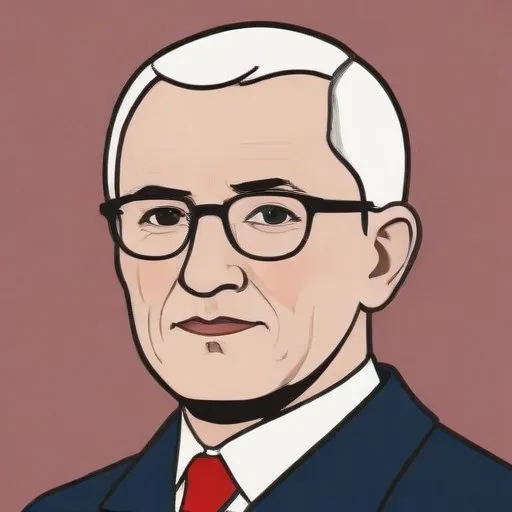
A French lawyer and politician who served as Minister of Police under Napoleon, notorious for his ruthless suppression of dissent and creation of a vast network of spies and informants.
Joseph Fouch, the 1st Duc d'Otrante, is infamous for his brutal suppression of the Lyon insurrection during the French Revolution in 1793 and his tenure as Minister of Police under Napoleon Bonaparte. This cunning statesman was a master of manipulation, using his intelligence and cunning to navigate the treacherous waters of Revolutionary France.
Born on May 21, 1759, in Le Pellerin, a small village near Nantes, Fouch was the son of Julien Joseph Fouch and Marie Françoise Croizet. He demonstrated a keen aptitude for literary and scientific studies at the College of the Oratorians in Nantes, and later at an institution in Paris, where he was initiated into Freemasonry in 1788.
Fouch's teaching career took him to various colleges, where he became acquainted with Maximilien Robespierre and his sister Charlotte. As the French Revolution gathered momentum, Fouch's democratic leanings and anticlericalism earned him popularity in Nantes. He became a leading member of the local Jacobin Club, and when the College of the Oratorians was dissolved in 1792, Fouch joined the Revolution full-time.
In 1793, Fouch was instrumental in crushing the Lyon insurrection, earning him notoriety for his ruthlessness. His actions caught the attention of Maximilien Robespierre, who appointed him as the representative-on-mission to the Army of the Alps.
Under the Directory, Consulate, and Empire, Fouch served as Minister of Police, using his cunning and intelligence to manipulate and control. He became Napoleon's subordinate, and his skills in surveillance and repression made him an invaluable asset to the Emperor.
In 1815, Fouch served as President of the Executive Commission, the provisional government of France installed after Napoleon's abdication. He died on December 25, 1820, leaving behind a complex legacy of brutality and cunning.
Fouch's anticlericalism and democratic leanings were shaped by his involvement with the Jacobin Club and his exposure to Enlightenment thinkers. His pragmatic approach to politics, however, often led him to prioritize power over principle.
Fouch's life and career were marked by the tumultuous backdrop of the French Revolution and Napoleon's rise to power. His legacy is a testament to the complexity of human nature, where cunning and brutality can coexist with intelligence and charm.
Fouch's story serves as a reminder of the darker aspects of human history, where ruthlessness and manipulation can be used to achieve power. Yet, it also highlights the importance of understanding the historical context in which individuals like Fouch operated, and the nuances of human character that make us all complex and multifaceted.
Born in 1769
A French military leader who rose to prominence during the French Revolution and became Emperor of France, known for his military conquests and reorganization of Europe. He is also famous for his Napoleonic Code, which remains a foundation of modern law.
Born in 1758
Radical leader of the French Revolution, instrumental in the Reign of Terror, and advocate for the execution of King Louis XVI.
Born in 1755
A key figure in the French Revolution, leading the coup that overthrew Maximilien Robespierre and later serving as a key advisor to Napoleon Bonaparte. He played a crucial role in shaping French politics during a tumultuous period.
Born in 1759
A leading figure of the French Revolution, instrumental in the overthrow of the monarchy and establishment of the First French Republic, known for his radical Jacobin ideology.
Born in 1760
French journalist and politician who sparked the French Revolution with his impassioned speeches and writings, advocating for democracy and social reform.
Born in 1753
A French general, mathematician, and politician who played a crucial role in the French Revolution and is considered the "Organizer of Victory" for his military strategies, and also made significant contributions to mathematics and engineering.
