


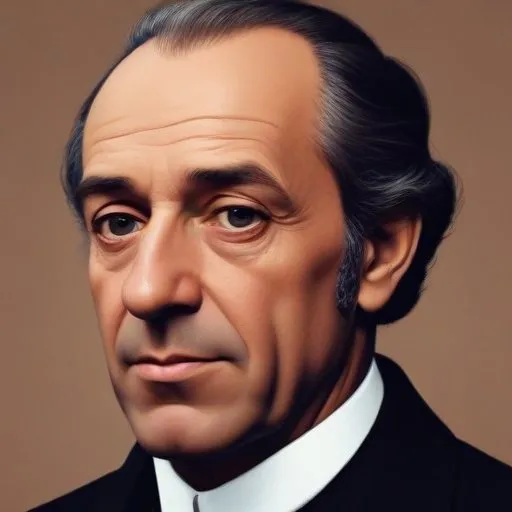
A French mathematician, economist, and academic who made significant contributions to probability theory, statistics, and economics, particularly in the development of the Bertrand paradox.
Joseph Louis François Bertrand was a French mathematician who left an indelible mark on the field of probability theory. He is best known for his work on the Bertrand's Paradox, a seemingly simple yet profound problem that challenges our understanding of probability and has far-reaching implications for fields such as statistics, engineering, and economics.
Born on March 11, 1822, in Paris, France, Bertrand was educated at the Lycée Louis-le-Grand and later at the École Polytechnique, where he graduated in 1843. He went on to receive his doctorate in mathematics from the University of Paris in 1853.
Bertrand's most significant contribution to mathematics is his work on probability theory. His book, "Calculus of Probabilities," published in 1888, is considered a seminal work in the field. In it, he introduced the concept of Bertrand's Paradox, which questions the axiom of choice and has sparked intense debate among mathematicians.
In addition to his work on probability theory, Bertrand made significant contributions to other areas of mathematics, including differential geometry, algebra, and number theory. He was also an accomplished teacher and served as a professor of mathematics at the University of Paris from 1862 until his death in 1900.
Bertrand's Paradox is a classic problem in probability theory that goes as follows: Imagine you have a circle and three chords are drawn at random. What is the probability that the three chords form a triangle? Bertrand showed that the answer depends on the method used to draw the chords, and this led to a deeper understanding of the nature of probability.
Bertrand's work on probability theory has had a profound impact on many fields, including statistics, engineering, and economics. His paradox has been the subject of much debate and has inspired new areas of research, such as game theory and decision theory.
Little is known about Bertrand's personal life, but it is recorded that he was a quiet and introverted person who preferred the company of his books and papers to social gatherings. He never married and had no children.
Bertrand's work was not without controversy. Some mathematicians criticized his paradox for being too abstract and lacking practical applications. However, Bertrand's defenders argued that the paradox was a thought-provoking exercise that shed light on the fundamental nature of probability.
Bertrand was elected as a member of the French Academy of Sciences in 1856 and served as its president from 1895 to 1896. He was also awarded the Grand Prix des Sciences Mathématiques in 1897.
Bertrand's work on probability theory took place during a time of great change and upheaval in mathematics. His contributions helped to lay the foundations for modern probability theory and paved the way for future mathematicians such as Émile Borel and Andrey Kolmogorov.
Bertrand's legacy extends beyond mathematics to fields such as economics, engineering, and statistics. His paradox has become a classic problem in probability theory and continues to inspire new research and applications.
Born in 1789
Developed rigorous mathematical theories and introduced concepts like convergence and continuity, revolutionizing calculus and paving the way for modern mathematics.
Born in 1749
Developed nebular hypothesis of the origin of the solar system and formulated Laplace's equation, a fundamental concept in mathematics and physics. He's considered the founder of celestial mechanics.
Born in 1768
Developed the Fourier series, a mathematical tool used to decompose periodic functions into their component frequencies, and pioneered the study of heat transfer and thermodynamics.
Born in 1752
Developed the theory of elliptic integrals, and his work on number theory laid the foundation for modern cryptography.
Born in 1786
A mathematician and politician who made significant contributions to the development of electromagnetism and served as Prime Minister of France, advocating for social reform and education.
Born in 1811
Predicted the existence and location of Neptune, a previously unknown planet, through mathematical calculations, revolutionizing astronomy.
Born in 1774
A French polymath who made significant contributions to the fields of physics, astronomy, and mathematics, particularly in the discovery of chromatic polarization and the Biot-Savart law.
