


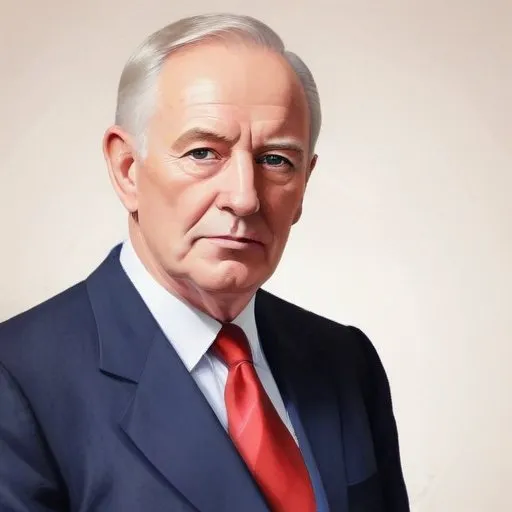
The 10th Prime Minister of Australia, a Labor Party leader who implemented significant economic reforms during the Great Depression, and also a former teacher and union leader.
Joseph Lyons, the tenth Prime Minister of Australia, left an indelible mark on the nation's history, serving from 1932 until his untimely death in 1939. As the founding leader of the United Australia Party (UAP), he navigated the country through the tumultuous years of the Great Depression, earning him a reputation as a shrewd and compassionate leader.
Born on September 15, 1879, in Stanley, Tasmania, Lyons began his career as a schoolteacher before venturing into politics. He was actively involved in the Australian Labor Party (ALP) from a young age and won election to the Tasmanian House of Assembly in 1909.
Lyons' political prowess was evident in his early years, as he rose through the ranks to become Treasurer of Tasmania (1912-1914) under John Earle. He later succeeded Earle as party leader in 1916. In 1923, Lyons became the 26th Premier of Tasmania, leading a minority government that was marked by moderate reforms and a successful negotiation of a constitutional crisis over the powers of the Legislative Council.
In 1929, Lyons resigned from state parliament to enter federal politics, winning an Australian House of Representatives seat in Labor's landslide victory. He was immediately appointed to cabinet by Prime Minister James Scullin, becoming Postmaster-General of Australia and Minister for Works and Railways. However, his orthodox financial policies led to a rift with the Labor caucus, and he eventually left the party in 1931 to sit as an independent. A few months later, his group merged with other opposition parties to form the United Australia Party, with Lyons at the helm as Leader of the Opposition.
Lyons led the UAP to a landslide victory at the 1931 election, becoming the Prime Minister of Australia. During his tenure, he implemented policies to alleviate the suffering of the Great Depression, including the establishment of the Australian Loan Council and the introduction of a national insurance scheme. His leadership was marked by a commitment to fiscal responsibility, social welfare, and nation-building.
Lyons' personal life was marked by tragedy, with the loss of his wife, Enid, in 1938. Despite this, he remained dedicated to his duties as Prime Minister. Lyons' legacy is that of a leader who navigated treacherous political waters with integrity and compassion. His commitment to the welfare of the Australian people has earned him a lasting place in the nation's history.
Joseph Lyons' unwavering dedication to the people of Australia has left a lasting impact on the nation's history. His legacy serves as a testament to the power of compassionate leadership and responsible governance. As Australia looks back on its past, it is impossible to ignore the significant contributions of this remarkable leader.
Born in 1894
The 12th Prime Minister of Australia, a lawyer-turned-politician who played a crucial role in shaping the country's post-war economy and foreign policy, and is often credited with establishing the modern Australian identity.
Born in 1885
Led the country through World War II, implementing policies to defend Australia and its economy. He's also known for his leadership during the country's transition from British to American influence.
Born in 1890
The 15th Prime Minister of Australia, serving for just eight days in 1945, known for being the shortest-serving prime minister in Australian history. He was also a prominent educator and politician.
Born in 1885
Australian engineer and politician who served as the 16th Prime Minister of Australia, implementing significant economic reforms and playing a crucial role in shaping the country's post-war development.
Born in 1894
The 13th Prime Minister of Australia, serving from 1941, known for his brief but significant term during World War II, and his role in shaping the country's economy.
Born in 1881
Early Hollywood pioneer who directed over 500 films and was a key figure in the development of the film industry. Known for his prolific output and innovative filmmaking techniques.
Born in 1867
Third Prime Minister of Australia, serving from 1904 to 1905, known for his efforts to establish a national government and implement progressive reforms.
Born in 1845
The 4th Prime Minister of Australia, a Scottish-Australian lawyer and politician who served from 1904 to 1905, known for his role in shaping the country's early years and contributing to its growth.
