


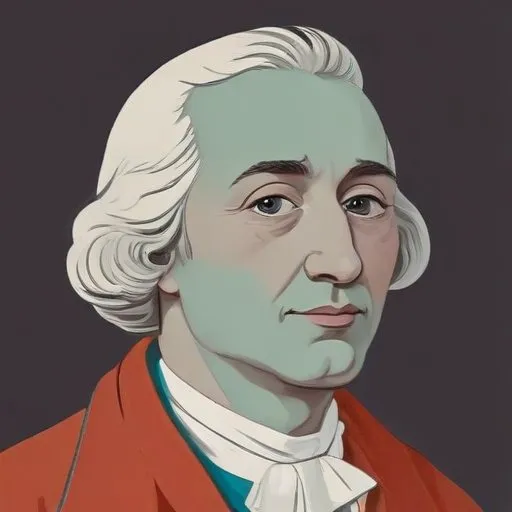
Joseph-Marie Vien, a renowned French painter, is best known for being the last holder of the prestigious post of Premier peintre du Roi, serving from 1789 to 1791. His remarkable career was marked by numerous honors, awards, and a lasting impact on the art world.
Born on June 18, 1716, in Montpellier, France, Vien was protected by Comte de Caylus, which enabled him to enter the studio of Natoire at a young age. He won the grand prix in 1745, a testament to his exceptional talent and dedication to his craft.
Vien's time in Rome was instrumental in shaping his artistic style, as he immersed himself in the study of nature and the masters. Upon his return to Paris, he faced initial rejection, but his perseverance paid off, and he was eventually admitted to the academy for his painting "Daedalus and Icarus" (Louvre), thanks to the protests of François Boucher.
In 1776, Vien became the director of the school of France at Rome, where he refused to take Jacques-Louis David as a pupil, citing David's age as a reason. Despite this, Vien went on to mentor many talented artists, including François-André Vincent, Jean-Antoine-Théodore Giroust, and Jean-Baptiste Regnault, among others.
After his return to Paris, Vien's fortunes were affected by the French Revolution. Undeterred, he continued to work tirelessly, and in 1796, at the age of 80, he won a prize in an open government competition. Napoleon Bonaparte recognized his merit by appointing him a senator.
Joseph-Marie Vien's legacy extends beyond his own remarkable career. His pupils went on to become prominent artists in their own right, and his influence can be seen in the development of French art in the late 18th and early 19th centuries. He passed away on March 27, 1809, and was buried in the crypt of the Panthéon.
Vien's wife, Marie-Thérèse Reboul (1728-1805), was also a member of the academy and an accomplished artist in her own right. Their son, Marie-Joseph, born in 1761, followed in his father's footsteps and became a notable painter.
Joseph-Marie Vien's remarkable life and career serve as a testament to his dedication, perseverance, and artistic genius. His influence on French art and his legacy as a teacher, mentor, and artist continue to inspire and captivate art lovers to this day.
Born in 1748
A French painter and illustrator who revolutionized Neoclassicism with his realistic and emotive works, creating iconic pieces like "Oath of the Horatii" and "Napoleon Crossing the Alps".
Born in 1770
A prominent Neoclassicist painter, renowned for his elegant and refined portraits of European aristocracy, capturing the essence of his subjects with precision and subtlety.
Born in 1780
A renowned French Neoclassicist painter and illustrator, celebrated for his exquisite portraits and historical scenes that epitomize elegance and refinement. His work continues to inspire artists and art enthusiasts alike.
Born in 1771
A French Neoclassicist painter who created dramatic, emotionally charged scenes, often depicting Napoleon's military campaigns and heroic events. His works are characterized by vivid colors and intense lighting.
Born in 1619
A dominant figure in 17th-century French art, he was a painter, art theorist, and director of the Gobelins Manufactory, creating grandiose and dramatic works that epitomized the French Baroque style. He wrote extensively on art theory, influencing generations of artists.
Born in 1659
A prominent portrait painter of the French monarchy and aristocracy, capturing the essence of 17th and 18th century European royalty with exquisite detail and realism.
Born in 1732
A prolific Rococo painter and etcher, renowned for his delicate, whimsical, and often erotic works that capture the carefree spirit of 18th-century French aristocracy. His art often featured lush landscapes, gentle colors, and playful scenes of love and leisure.
