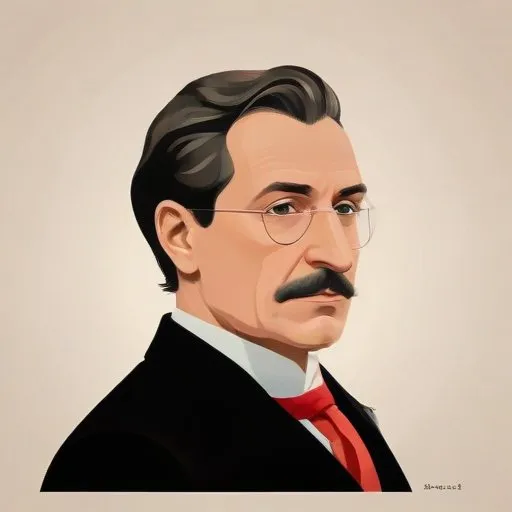
Joseph Petzval: The Visionary Behind Modern Optics and Photography
Joseph Petzval, a Hungarian mathematician, inventor, and physicist, revolutionized the fields of optics, photography, and cinematography with his groundbreaking contributions. He is renowned for developing the Petzval portrait lens and opera glasses, which remain in widespread use today.
A Life of Innovation
Born on January 6, 1807, in Szepesbla, Kingdom of Hungary (now Spisk Bel, Slovakia), Petzval's fascination with technology and mathematics was evident from an early age. His father, a teacher, organist, and geodesist, encouraged his son's curiosity, and Joseph went on to study at the Institutum Geometricum (now Budapest University of Technology and Economics) in Buda. He later lectured at the same institution and headed the Institute of Practical Geometry and HydrologyArchitecture between 1841 and 1848.
The Founding Father of Geometrical Optics
Petzval's most significant contributions lie in the field of geometrical optics. He is credited with the discovery of the Laplace transform and made extensive research on aberration in optical systems. His work laid the foundation for modern photography and cinematography, earning him recognition as one of the main founders of these fields.
Notable Inventions and Contributions
- Petzval Portrait Lens: Still widely used today, this lens allows for high-quality portraits with a unique aesthetic.
- Opera Glasses: Petzval's design enables sharp, clear images, making them a staple in theaters and opera houses worldwide.
- Laplace Transform: This mathematical concept, discovered by Petzval, has far-reaching implications in signal processing, image analysis, and other fields.
- Aberration Research: Petzval's work on aberration in optical systems paved the way for significant advancements in telescope and microscope design.
Awards and Recognition
Petzval's contributions did not go unnoticed. He was appointed to a chair of mathematics at the University of Vienna and became a member of the Hungarian Academy of Sciences in 1873.
Personal Life and Legacy
Petzval's family was filled with individuals gifted in technology and the arts. His father was a talented musician and composer, and his siblings shared his passion for innovation. Joseph Petzval passed away on September 17, 1891, leaving behind a legacy that continues to shape the world of optics, photography, and beyond.
Impact on Modern Society
Petzval's work has had a profound impact on modern society. His contributions to optics and photography have enabled us to capture and appreciate the world around us in unprecedented ways. The opera glasses, still widely used today, are a testament to his ingenuity and attention to detail.
In Conclusion
Joseph Petzval's remarkable life and achievements serve as a testament to the power of human innovation and creativity. His groundbreaking work in optics, photography, and cinematography continues to inspire generations, and his legacy will undoubtedly endure for centuries to come.
FAQ
What was Joseph Petzvals most significant contribution to optics?
Joseph Petzvals most significant contribution to optics was his development of the Petzval lens, a type of camera lens that corrected for spherical aberration and produced high-quality images.
How did Joseph Petzvals work on photography impact the development of the medium?
Joseph Petzvals work on photography helped to establish photography as a viable artistic medium, paving the way for later photographers such as Eadweard Muybridge and Julia Margaret Cameron.
What were Joseph Petzvals achievements in mathematics?
Joseph Petzval was a prolific mathematician who made significant contributions to the fields of differential equations, algebraic equations, and number theory. He was elected to the Hungarian Academy of Sciences in 1852.
How did Joseph Petzvals work on mathematics influence later mathematicians?
Joseph Petzvals work on mathematics influenced later mathematicians, including Henri Poincaré and David Hilbert, who built on his contributions to differential equations and algebraic equations.
What was Joseph Petzvals legacy in the history of science?
Joseph Petzvals legacy in the history of science is that of a mathematical physicist who made significant contributions to the development of optics, photography, and mathematics.