


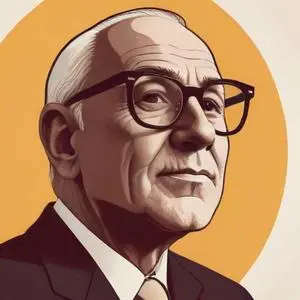
Designed iconic buildings that blend functionality with sculptural elegance, most famously the Sydney Opera House, a symbol of Australia.
Jrn Utzon is renowned for his iconic design of the Sydney Opera House, a masterpiece that has become synonymous with Australia's cultural identity. In 1957, Utzon's revolutionary design won an international competition, marking the beginning of a legacy that would span decades and cement his place in the annals of architectural history.
Born in Copenhagen, Denmark on April 9, 1918, Utzon was the son of a naval architect and grew up in Aalborg, where his fascination with ships sparked an early interest in design. His family's artistic inclinations nurtured his creative spirit, and in 1937, he enrolled in the Royal Danish Academy of Fine Arts, where he studied under esteemed architects Kay Fisker and Steen Eiler Rasmussen.
Utzon's early influences included the works of Gunnar Asplund and Alvar Aalto, whose modernist philosophies shaped his approach to design. Post-graduation, Utzon worked alongside Arne Jacobsen and Poul Henningsen in Stockholm, further refining his skills. His travels took him to Morocco, the United States, and Mexico, where he drew inspiration from indigenous architecture, including the pyramids and clay buildings that influenced his style.
In 1957, Utzon's innovative design for the Sydney Opera House won the international competition, despite being the youngest entrant. His revised design, completed in 1961, formed the basis of the landmark building, which would take 14 years to complete. The Opera House's dramatic curves and sweeping white sails have become an emblem of Australia, and Utzon's masterpiece has been recognized as a UNESCO World Heritage Site since 2007.
Utzon's architectural repertoire extends beyond the Sydney Opera House. His designs for the Bagsvrd Church near Copenhagen and the National Assembly Building in Kuwait showcase his versatility and creative range. His innovative approach to housing design, exemplified in the Kingo Houses near Helsingr, has had a lasting impact on modern architecture.
Utzon's contributions to architecture have been recognized globally. He received the Pritzker Architecture Prize in 2003 and was named an honorary Companion of the Order of Australia in 1985. In 2007, Utzon became the second person to have a work recognized as a World Heritage Site during his lifetime, a testament to his enduring legacy.
Jrn Utzon's work has not only reshaped the architectural landscape but has also inspired generations of designers, engineers, and artists. His commitment to innovation, creativity, and functionality has left an indelible mark on modern architecture. As we look back on his remarkable life and achievements, we are reminded of the power of vision, imagination, and dedication to leave a lasting impact on humanity.
"The way I saw it, the building would be like a work of art, not just a building."
― Jrn Utzon
Jrn Utzon's life and works serve as a testament to the power of creativity, innovation, and perseverance. As we reflect on his remarkable journey, we are reminded of the enduring impact of his architectural masterpieces and the boundless potential of human imagination.
Born in 1910
A Finnish-American architect and furniture designer who created iconic, futuristic structures and designs that blended art and functionality, including the iconic Gateway Arch.
Born in 1901
A renowned architect celebrated for designing iconic, modernist buildings that blend functionality with aesthetic appeal, leaving a lasting impact on the world of architecture.
Born in 1917
A renowned architect who designed iconic buildings that blend modernity with cultural sensitivity, leaving an indelible mark on the urban landscape.
Born in 1867
Visionary architect behind iconic, harmonious structures that blend seamlessly into their surroundings, redefining modern American architecture.
Born in 1887
A pioneer of modern architecture, famous for designing innovative, functional, and visually striking buildings that transformed urban landscapes. His works continue to inspire architects and designers worldwide.
Born in 1883
A pioneer of modernist architecture, he designed iconic buildings that blended functionality with aesthetics, including the John F. Kennedy Federal Building. His work continues to inspire architects and designers today.
Born in 1892
A pioneering architect who designed iconic buildings that blended seamlessly into their surroundings, revolutionizing modernist architecture with his sleek, functional, and elegant style.
