


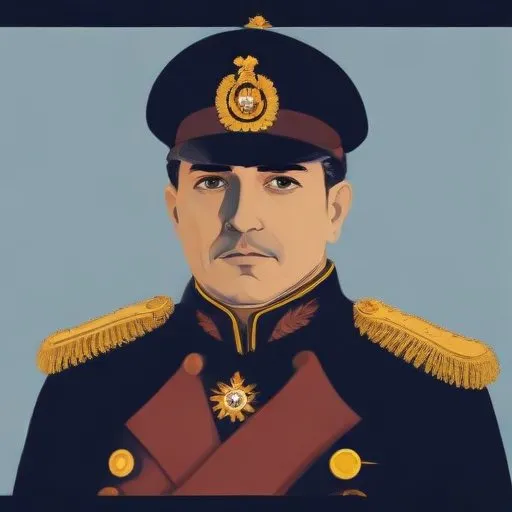
A dominant figure in 19th-century Argentina, he ruled with an iron fist, modernizing the economy and military while suppressing opposition, earning a reputation as a strong but brutal leader.
Juan Manuel de Rosas, also known as the "Restorer of the Laws," was a prominent Argentine politician and army officer who ruled Buenos Aires Province and briefly the Argentine Confederation. He is infamous for his authoritarian regime, marked by state terrorism, censorship, and repression, earning him the title of one of the most controversial figures in Argentine history.
Born on March 30, 1793, into a wealthy family, Rosas began his career as a rancher and gradually amassed a vast fortune through his shrewd business dealings. He enlisted his workers in a private militia, a common practice for rural proprietors, and participated in the disputes that led to numerous civil wars in Argentina.
Rosas' military prowess and personal influence garnered him a loyal following, and he eventually became a caudillo, a provincial warlord. He rose through the ranks to become a brigadier general, the highest rank in the Argentine Army, and became the undisputed leader of the Federalist Party.
In December 1829, Rosas became the governor of Buenos Aires Province and established a dictatorship backed by state terrorism. He signed the Federal Pact in 1831, recognizing provincial autonomy and creating the Argentine Confederation. However, when his term of office ended in 1832, Rosas departed to the frontier to wage war on the indigenous peoples.
After his supporters launched a coup in Buenos Aires, Rosas was asked to return and once again took office as governor. He reestablished his dictatorship and formed the repressive Mazorca, an armed parapolice that killed thousands of citizens. Elections became a farce, and the legislature and judiciary became docile instruments of his will.
Rosas was known for his authoritarian personality and his regime became totalitarian in nature, with all aspects of society rigidly controlled. He created a cult of personality, with his image and propaganda omnipresent in Argentine society.
Rosas faced numerous threats to his power, including wars against the Peru-Bolivian Confederation, a French blockade, and internal revolts. However, he persevered and extended his control over the country, suppressing dissent and opposition with an iron fist.
Juan Manuel de Rosas' regime had a profound impact on Argentine society and politics. His authoritarian style of governance and repressive tactics have been widely criticized, and his legacy remains controversial to this day.
Despite his controversial reputation, Rosas' contributions to Argentine history cannot be denied. He played a significant role in shaping the country's political landscape and his influence can still be seen in modern Argentine society.
Juan Manuel de Rosas' life and legacy serve as a testament to the complexities of Argentine history and politics. While his authoritarian regime was marked by repression and violence, his influence on the country's development cannot be ignored.
Born in 1811
A pioneering journalist and politician who modernized Argentina's education system and infrastructure, earning him the nickname "Father of Education" in Argentina.
Born in 1821
A 19th-century leader who modernized Argentina's economy and infrastructure, and is also revered for his literary and journalistic contributions.
Born in 1770
A key figure in Argentina's struggle for independence, he created the country's flag and played a crucial role in its early development.
