


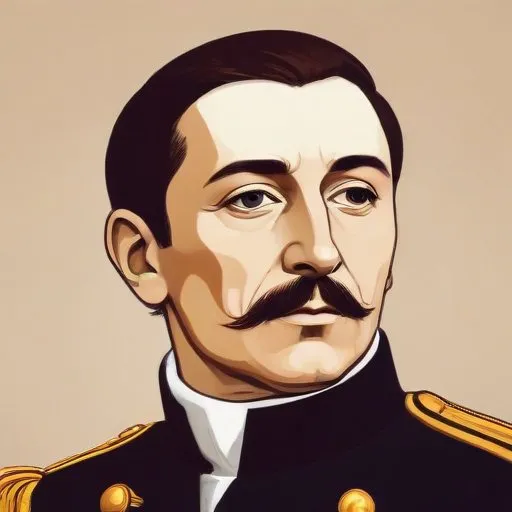
A French naval officer who led expeditions to the Pacific and Antarctica, discovering new lands and mapping uncharted territories. He's credited with discovering the Venus de Milo statue.
Jules Dumont d'Urville is renowned for his extraordinary voyages of discovery, mapping the unexplored regions of the South and Western Pacific, Australia, New Zealand, and Antarctica. As a botanist, cartographer, and naval officer, his name is etched on several seaweeds, plants, shrubs, and places, including the d'Urville Island in New Zealand.
Born on May 23, 1790, in Conde-sur-Noireau, Lower Normandy, d'Urville was the son of Gabriel Charles Francois Dumont, sieur d'Urville, and Jeanne Francoise Victoire Julie. His father's death when d'Urville was just six years old led his mother's brother, the Abbot of Croisilles, to take on the role of his father and oversee his education.
The Abbot instilled in d'Urville a love for learning, teaching him Latin, Greek, rhetoric, and philosophy. From 1804, d'Urville studied at the Lyceé Impérial in Caen, where he devoured the works of the Encyclopédistes and the travel reports of Bougainville, Cook, and Anson, sparking his passion for exploration.
In 1807, d'Urville joined the École Navale in Brest, presenting himself as a shy, studious young man with little interest in amusements and a keen focus on studies. He quickly rose through the ranks, obtaining the grade of first-class candidate in 1808.
However, the French navy at the time was in a state of decline, blockaded by the British Royal Navy's dominance. D'Urville's early years in the navy saw him confined to land, where he continued to study and prepare for his future voyages.
D'Urville's first major voyage took place from 1826 to 1829, during which he explored the Pacific, sailing around the world on the Cochin China. He surveyed the coast of New Guinea, mapped the Loyalty Islands, and discovered the Voyageuse Strait in the Solomon Islands.
His most notable expedition took place from 1837 to 1840, when he led the Astrolabe and Zélée on a journey to the Antarctic Circle. During this voyage, d'Urville discovered the Adélie Coast, the Dumont d'Urville Station, and the Pointe Géologie.
D'Urville's contributions to cartography, botany, and exploration earned him numerous honors, including the Grand Prix of the French Academy of Sciences and the title of Rear-Admiral.
Today, his name is commemorated in various places, including the d'Urville Sea, the d'Urville Island in New Zealand, and the Dumont d'Urville Antarctic Station. His legacy continues to inspire generations of explorers, scientists, and cartographers.
D'Urville's life was a testament to his boundless curiosity, his thirst for knowledge, and his unwavering dedication to the pursuit of discovery. His legacy continues to inspire us today, reminding us of the importance of exploration, scientific inquiry, and the human spirit of adventure.
41 Years Old
A Welsh rugby union player who captained Wales and the British and Irish Lions, known for his exceptional skill and leadership on the pitch.
Born in 1774
Mapped the coastline of Australia, creating the first complete chart of the continent, and is credited with giving Australia its name.
Born in 1754
French cartographer and explorer who mapped the Australian coast and discovered several islands, significantly contributing to the field of cartography.
Born in 1809
Developed the theory of evolution through natural selection, revolutionizing our understanding of life on Earth. This groundbreaking idea transformed the fields of biology, ecology, and beyond.
Born in 1868
Led a British expedition to the South Pole, racing against a Norwegian team, and tragically perished on the return journey. He is remembered for his bravery and sacrifice in the pursuit of scientific discovery.
